

Urban Pipe Gallery Mold: Recommended Types and Buying Tips for Contractors
2026-10-19
Every contractor knows that urban pipe gallery projects demand molds that can handle tight spaces, variable loads, and relentless schedules. But with so many options flooding the market, how do you separate a workhorse from a headache? At LugongMachinery, we’ve watched too many teams lose days to warped forms and poor fits. That’s why this guide cuts through the noise: we break down the recommended mold types for modern pipe galleries and share hard-won buying tips that go beyond glossy brochures. Read on to discover what actually holds up underground—and what quietly eats your margin.
Match the Mold to the Pipe Gallery Cross-Section Before You Bid
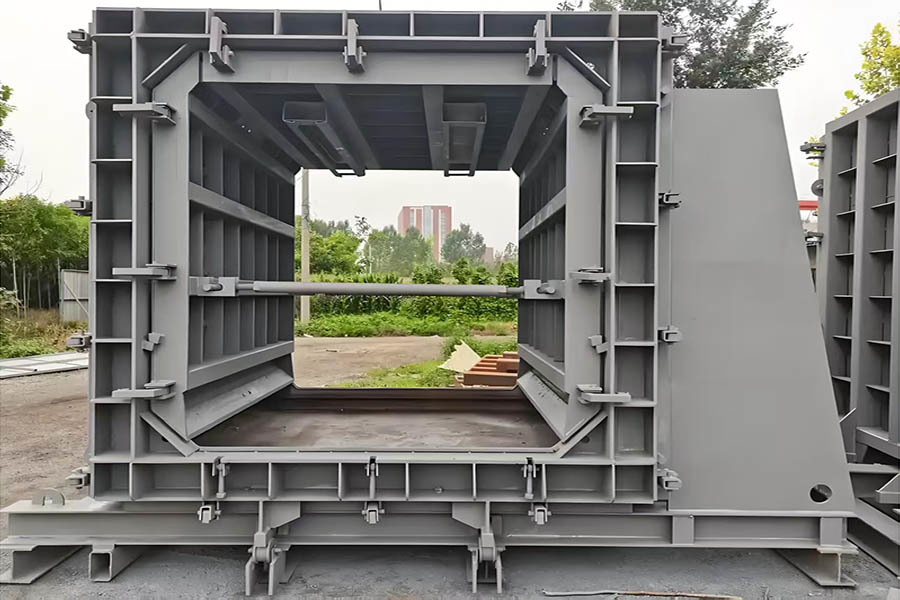
Before you put a number on the table, pull the pipe gallery cross-section drawings and set them side by side with the mold profile. The interior shape of the mold must trace the exact same corners, slopes, and wall transitions shown on the plans. A mold that looks close on paper but misses a haunch angle or changes the keyway location by an inch will force you to pour extra concrete, shim the form, or re-cut joints after every cycle. Ask the mold supplier for a sectional drawing of the form itself, then overlay it against the project's pipe gallery cross-section. Do not trust nominal sizes like 8-foot by 6-foot; verify the actual inside dimensions at the widest point, the narrowest point, and the invert.
Make this check before bidding because the cost of modifying a mold after award can wipe out your margin. If the pipe gallery cross-section changes at intersections, grade breaks, or special structures, confirm that the same mold can handle every variation or that the bid includes the right insert panels. Look for fixed side rails that will not adjust to the required wall thickness, or a bottom form that leaves the wrong floor slope. Even a small mismatch in the crown or springline will show up on every section you cast. A quick overlay sketch with the mold profile traced onto the cross-section takes fifteen minutes and can save you from bidding a form that fights the geometry all job long.
Steel, Fiberglass, or Polymer: Choosing Based on Pour Volume and Site Access
On large commercial slabs where you're moving 20 or 30 yards a day, steel forms earn their keep. They shrug off the constant striking, scraping, and re-setting that would chew up lighter materials, and their rigidity keeps edges from bowing under the hydrostatic pressure of deep lifts. But that same toughness comes with a real trade-off once you're away from the truck: steel panels are heavy, and if the pour site has soft ground, narrow gates, or a stair-stepped back yard, you'll burn more labor just getting them into place than you spend on the actual pour.
Fiberglass sits in a useful middle ground. It handles high-volume runs better than polymer because the panels resist warping and don't absorb water, yet at roughly half the weight of steel it won't destroy a two-man crew on a hillside or a site with no machine access. The downside shows up most in rocky or debris-laden subgrades—fiberglass edges chip more readily than steel, so a careless shovel strike becomes a repair job rather than a shrug.
Polymer forms are the quiet workhorse for residential and light commercial pours, especially where access means carrying everything through a 32-inch doorway or down a flight of stairs. They're light enough to stack and walk in by hand, and for volumes under about ten yards they hold line just fine. Push them into sustained high-volume production, though, and the repeated prying and vibration from larger screeds will start to loosen connections, so the real decision isn't about which material is "best" but about whether your pour volume and site access punish weight more than they punish fragility.
Collapsible Cores vs. Fixed Cores for Urban Pipe Galleries
When laying out the internal formwork for urban pipe galleries, the choice between collapsible cores and fixed cores often shapes not just the construction speed but the entire sequence of how a utility corridor gets built. A fixed core demands patience: it stays in place through the concrete pour, needs to be stripped or left as lost formwork, and forces you to think about stripping space, access hatches, and end openings. Collapsible cores, on the other hand, introduce a mechanical hinge or scissor system that lets the form retract inward after the concrete has gained enough strength, pulling away from fresh surfaces without dragging or scoring them. In tight city sites where a pipe gallery runs under a busy road or between existing foundations, that ability to collapse and slide the core out through a narrow access shaft can free up a schedule that would otherwise be stuck waiting for larger demolding clearances.
There is a trade-off, though, and it usually shows up in the cost of the core itself and the tolerance you need to hold during fabrication. A simple fixed core can be nothing more than welded steel plate or ribbed plywood stiffened with timber, cheap to make and tolerant of minor misalignments. Collapsible cores need precision-machined hinge points, uniform gap settings, and a release mechanism that operates without jamming after repeated pours. For a pipe gallery with a rectangular cross-section and a consistent run of several hundred meters, a collapsible core can be reused dozens of times with very little surface repair, while a fixed core might need to be cut into short segments just to get it out of the completed bay. Yet if the gallery profile changes frequently—say, a transition from a twin-cell box to a single large duct—a collapsible system has to be re-engineered for each new dimension, while simple fixed cores can be adapted on site with angle grinders and extra bracing.
Field crews tend to develop strong opinions here. Some prefer the predictability of a fixed core because there is no mechanical linkage to fail underground; once the concrete is poured and cured, you break the form loose with pry bars and pull it out in pieces. Others favor the collapsible approach precisely because it avoids that prying and hammering against young concrete, reducing the chance of edge spalling or micro-cracking around utility penetrations. In an urban pipe gallery, where the inner surface often carries waterproofing membranes or cable tray anchors, those small surface defects are not cosmetic. The best choice usually comes down to how many reuses you actually get, whether the gallery has a repetitive cross-section, and how willing the crew is to maintain and adjust a more complex form instead of just welding up a new fixed panel when something gets bent.
Dimensional Tolerances That Actually Show Up in the Field
You don't see most dimensional tolerances until they force a crew to break out a torch or a tube of expensive sealant. Anchor bolts set ½" out of place, a shear tab that misses its beam web by 3/8", or a stair tower that lands 1" off the floor opening—these are the numbers that matter in the field. The spec might allow ±1/4" for the bolt group, but if the template got bumped during the pour, the erector is slotting holes and the inspector is looking the other way. Field reality is less about absolute numbers and more about whether the next trade can make it work without a change order.
What catches people off guard is the way tolerances stack across materials that don't share the same assumptions. Concrete guys think an inch is tight; steel erectors work to a sixteenth; curtain wall installers want an eighth. When the slab edge wanders +3/4" and the steel line is set -1/4", the storefront system has to absorb nearly an inch of slop that nobody designed for. You end up with shim packs thicker than the base plate, reveal joints wandering like a country road, and caulk joints doing structural work. The fix is never in the individual trade's tolerance table—it's in the interface.
Out-of-square framing is the tolerance you feel before you measure it. A wall can be within individual trade tolerances—say 1/2" over 10 feet—but when the cabinet installer, countertop fabricator, and door hanger all use that same wall as a reference, the small error turns into tapered reveals, uneven overhangs, and doors that swing open on their own. Good field engineers stop checking isolated dimensions early. They pull diagonals, measure endpoint to endpoint, and compare relative plumb between adjacent walls, because that's where the actual field condition lives.
Supplier Questions That Reveal More Than a Brochure
A brochure lists capabilities, tolerances, certifications. But it rarely shows how a factory behaves when a batch fails inspection. Ask about the last time they had to scrap an entire production run and what they told the buyer. Their answer will reveal whether they own mistakes or hide them. Ask what percentage of orders ship on the originally quoted date—not the revised date. If they hesitate, that's your answer.
Push beyond standard 'what's your MOQ?' questioning. Ask for the name of a client who left them and why. Ask what material or process they would never recommend, even if it costs them business. A supplier who can name a weakness or a regret is giving you more than a glossy PDF ever will. Watch for answers that start with 'honestly' or 'to be honest'—that's often where the real information starts.
Storage, Repair, and Turnaround Habits That Keep Molds in Rotation
Most toolrooms treat mold storage as an afterthought, but the shops that keep projects moving treat every rack like a workstation. A mold pulled from storage should never need a surprise teardown. That means controlled humidity, capped water lines, and a quick visual checklist on the door of each storage bay. If a mold sits for more than a few weeks, someone walks past it with a flashlight and a rag, not just a clipboard. Small practices like tagging the last maintenance date on the lifting bar or leaving a silica gel packet in the runner system prevent the kind of corrosion and seized slides that kill turnaround time later.
Repair habits separate shops that keep molds in rotation from those that constantly swap in backups. Instead of waiting for flashing or short shots, good teams schedule pull-and-inspect intervals based on cycle count, not calendar dates. When a mold does come out, the repair bench follows the same sequence every time: clean first, measure critical shutoffs, then document what actually changed. A worn ejector pin gets replaced before it bends. A sticky guide pin gets polished before it scores a pocket. These habits feel mundane, but they stop small wear from becoming a Monday morning emergency.
Turnaround is where the rotation really gets tested. The fastest shops don't rush the repair—they shorten the wait around it. That means staging common spare parts near the bench, keeping hot runner controllers labeled and tested, and having one person own the mold's history instead of passing it between shifts. When a mold comes out of the press, the clock starts. The team that can clean, swap known wear items, and get it back in the machine without a second setup often wins the schedule. And if the mold needs more than a quick hit, they say so early and line up the next job rather than letting a half-ready tool block the rotation.
FAQ
For most urban pipe gallery jobs, a hydraulically operated steel mold with integrated side panels and a top inner form is the practical choice. It allows crews to set and strip quickly between pours. If the project has multiple cross-sections or unusual utility openings, modular bolt-together molds give more flexibility but require extra labor. For straight monotonic runs, a single-piece tunnel form with wheels can be moved along the track faster than anything else. Avoid relying on timber-sided molds for this kind of work; they don't hold tolerance over long walls and tend to leak at joints under concrete pressure.
Hydraulic molds win on speed once they're set up. You can strip and reposition in a fraction of the time it takes to loosen bolts and pry panels. But they're heavier and need a level, hard runway. Manual systems cost less upfront and can work in tighter urban sites, but you pay for it in labor hours and alignment headaches. On a tight schedule, the hydraulic system often pays for itself by cutting one day off each pour cycle. Just make sure the power pack is reliable and has spare hoses on site.
Look at the faceplate first, not just the main frame. A 6 mm faceplate with heavy channel stiffeners is more useful than an 8 mm plate on a wide unsupported span. Tap the plates; if they sound thin in the middle or show waviness near the stiffener welds, walk away. Also check the corners and pour-height areas - those take the most pressure and often get dented. A good supplier will list plate thickness for the face, side rails, and bulkheads separately rather than giving one vague number for the whole mold.
It depends on how many pours you have and whether the cross-section changes. For a long run with consistent internal dimensions, a custom-sized monoblock mold is faster and holds line better. But if the job includes chambers, junctions, or multiple pipe gallery widths, modular panels with pin connections save you from buying a second full set. The drawback is more assembly time and more joints to seal. Many contractors use a hybrid: custom main wall panels with modular end shutters and opening formers.
The biggest one is chasing the lowest weight. Lightweight molds flex under concrete pressure, causing wall thickness variation and honeycombing. Another mistake is ignoring the stripping sequence. If the inner form doesn't collapse enough to clear the top slab, you'll fight it on every cycle. Also, some buyers skip asking about spare parts lead time for hydraulic cylinders and vibrator mounts. Downtime waiting for a seal kit can wipe out any savings. Finally, not matching the mold to the actual concrete mix design - especially aggregate size and slump - leads to plugging in narrow side gaps.
Very important, but it's often treated as an afterthought. For long wall sections, external vibrators mounted on the mold beat relying on internal pokers, which can leave shadowing near cross joints. Look for molds with evenly spaced vibrator mounting plates rather than a few tacked-on brackets. The power supply and frequency should match the concrete mix; too much low-frequency vibration can segregate aggregate near the face. If you can, ask for a demo or previous project photos showing finished wall surfaces. A good vibration setup also reduces the need for patching later.
Clean the faceplates immediately after stripping, not the next morning. Use a plastic scraper or low-pressure water; chipping hammers dent the steel. Apply a release agent sparingly - thick coats build up and stain the concrete. Check alignment pins and hydraulic fittings weekly during heavy use. After every ten pours or so, lay a straightedge across the faceplates to catch bowing early. Store molds on firm, level ground with supports under the bulkheads, not on the panel edges. A little routine attention avoids costly flatness repairs later.
Usually yes, especially if your crew is on hourly wages. Side panels that swing out on hinges or slide on rollers save 20-40 minutes per cycle compared to crane-lifted loose panels. Over a 50-pour project, that's several full shifts. The added cost of the mechanism is often less than the labor it saves. Just make sure the moving parts are robust enough for site conditions - dirt and concrete splatter can jam cheap rollers. Look for greasable pins and bolt-on wear strips that can be replaced without cutting the frame.
Conclusion
A mold that worked on a suburban box culvert can turn into a nightmare inside a tight urban pipe gallery, so the first move is not to bid until you have the cross-section drawings in hand. Whether the gallery is rectangular, arched, or has offset utility ledges, the mold has to match those details or you will be shimming and patching on site. For contractors doing high-volume pours with crane access, steel holds up longest but weighs enough to slow repositioning. Fiberglass suits mid-range pours where you need a lighter form that still keeps its shape, while polymer makes sense on scattered, low-volume repairs where you can hand-carry panels through narrow alleys. In cramped city work, collapsible cores often beat fixed cores because they let you strip and move without knocking into rebar or adjacent structures, but they demand more careful assembly and inspection before each use.
Field tolerances are where the real costs show up, so ask for measured drawings, not just nominal dimensions, and verify that corner radii and wall thickness variations are within what your crew can finish without grinding. When talking to suppliers, dig past the brochure: ask how they handle last-minute dimensional changes, what their actual lead time is after approval, and whether they can deliver replacement parts quickly. Finally, storage and repair habits decide how long a mold stays in rotation. A dedicated flat storage area, immediate patch-up of dents or rust, and a schedule for stripping agent application keep turnaround times short. If you treat the mold as a consumable, it will fail mid-project, but with the right questions and maintenance, one good set can handle multiple urban gallery pours without losing accuracy.
Contact Us
Contact Person: Zhang Zhenlai
Email: [email protected]
Tel/WhatsApp: 8618563210000
Website: https://en.lugongmachinery.com/