

Top 10 UPS Uninterruptible Power Supply Factories from China for Reliable Power Backup
2026-11-26
Few things expose a business’s weak spots faster than a sudden blackout. Instead of waiting for the next grid failure, more buyers are turning to China’s top UPS manufacturers, where proven engineering meets practical pricing. Among the names worth watching, Wenma stands out for turning compact designs into dependable runtime when power quality matters most. This roundup highlights ten factories that consistently deliver, along with the strengths that set each one apart.
Where Reliable Backup Power Starts Before Assembly
Reliable backup power isn't something you bolt on at the end — it starts long before the first component touches the workbench. Every unit begins with a careful review of load requirements, runtime expectations, and the environment where it will actually live. That early attention to detail shapes decisions about battery chemistry, inverter sizing, and enclosure protection, so the final assembly isn't just a collection of parts but a system that already fits its intended job.
Before wiring and mounting ever happen, components are pulled from vetted suppliers and checked against the specific demands of the build. Connectors are matched to current ratings, cooling paths are planned for real operating conditions, and control boards are configured to handle the start-up sequences the equipment will face. These quiet, pre-assembly steps take time, but they prevent the kinds of surprises that show up later as overheated terminals or batteries that never quite reach their stated capacity.
What emerges from this stage is a foundation that the assembly team can trust. Instead of improvising solutions mid-build, technicians follow a clear path where every connection point and protective device already has a reason to be there. That is why dependable backup power rarely announces itself with a single dramatic feature — it comes from the accumulated decisions made before the tools are even picked up.
A Walk Through Chinese UPS Production Lines That Last
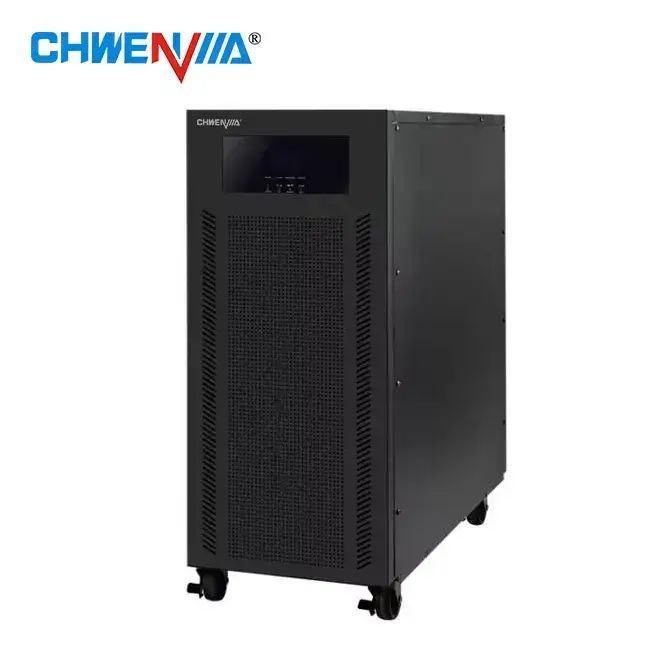
Walking these Chinese UPS production floors, the first thing that stands out is how much manual skill still sits inside what looks like automated hardware. At one station a technician presses thick copper busbars into place, checking torque settings by hand before the next worker locks the inverter module. Conveyor stops are rare, but when one occurs, the line lead gathers three or four people around a single chassis rather than waiting for a distant engineer.
Further down, burn-in racks run around the clock in a separate glass-walled room. The heat there is physical, not just a number on a panel. Units sit loaded to 80 percent or more, cycling through simulated grid drops and generator handoffs every few minutes. Workers log results on paper cards even though the test software records everything, because a written note about an odd fan pitch has caught failures before sensors flagged them.
What makes the line last is less about a single machine and more about replaceable subassemblies. Each UPS is built so a failed rectifier, fan tray, or control board can be swapped without tearing the entire cabinet apart. In the final bay, older units returned from the field are stripped at the same benches that assemble new ones, which means the people who build them also see how their work ages.
The Battery and Board Decisions Behind Longer Runtime
Runtime starts with a simple trade-off: store more usable energy or spend less of it along the way. The cell sets the upper limit, but the board determines how much of that energy actually reaches the load. A larger battery does not compensate for a regulator that burns several points of efficiency as heat, especially in compact designs where thermal headroom is already thin.
Quiescent current often matters more than peak draw once a device spends most of its life asleep. The choice between an always-on LDO and a switching converter, the pull-up values on idle lines, and whether a sensor rail stays powered between readings can quietly decide whether runtime gains come from chemistry or from discipline in circuit design.
Load behavior also reshapes the battery decision itself. Cells sag under heavy pulses and lose usable capacity as temperature rises, so a board that keeps power stages away from the cell and uses lower-resistance copper can extract more from the same pack. Matching the charge curve and cutoff voltage to how the device actually draws current stretches runtime in ways a raw milliamp-hour figure never captures.
How Factory Testing Separates Dependable Units from the Rest
A quick visual inspection rarely tells you much. Two drives can share the same enclosure, the same nameplate, and the same firmware version, yet behave very differently after six months in the field. The difference usually traces back to what happened before they left the factory. Dependable units are the ones that survived a longer, more demanding screening process: full-load runs, thermal cycling, insulation stress, and fault-response checks that go well beyond a simple power-on test.
Factory testing also exposes problems that only appear when conditions stack up. A unit may hold voltage perfectly in a cool test bay, then drift when the ambient temperature climbs and the line voltage sags at the same time. Testing under those overlapping stresses is slower and more expensive, which is why not every manufacturer does it. The units that ship after that kind of validation tend to be the ones that do not generate frantic service calls later.
That is the real split between a unit that simply works on day one and one that is still working years later.
What Buyers Miss When They Only Compare Spec Sheets
A spec sheet is useful for narrowing down a list, but it creates an illusion that products with matching numbers are interchangeable. Two machines can share the same motor wattage, battery capacity, or sensor resolution and still feel completely different in regular use. One may throttle earlier because its cooling path is indirect. Another may deliver flat audio because the speakers were tuned to a generic curve. The number on the page does not capture those decisions.
Durability and ergonomics are even harder to compare on paper. A lid that feels tightly damped on day one can loosen after repeated use, while a slightly heavier design with better weight distribution stays comfortable over long sessions. Small choices in materials, hinge design, button travel, and texture show up weeks later, not in the showroom. Buyers who only compare columns never see whether the product remains pleasant after the honeymoon period ends.
Support quality also sits outside the table. Whether a company ships timely fixes, keeps replacement parts available, or answers a warranty claim without a long email chain changes the total cost of ownership. A modest spec advantage rarely offsets months of friction with a silent support team. The better purchase is often the one that feels less impressive on a spreadsheet but more predictable in daily life.
When a UPS Factory Becomes a Long-Term Power Partner
A UPS factory that sticks around after the sale tends to learn things a brochure never captures. It sees which components actually hold up under repeated brownouts, which battery cabinets get reordered years later, and where field failures cluster. That accumulated knowledge quietly reshapes how units are built, tested, and matched to the loads they will carry.
The relationship often starts with a standard cabinet, but it rarely stays there. Engineers at the factory begin asking about startup currents, ambient temperatures, generator compatibility, and the rhythm of power cuts on site. Those conversations turn into small changes: a different breaker curve, a wider input window, a battery string sized for longer runtime, firmware adjusted to stop nuisance alarms. It is less about selling more hardware and more about making sure the hardware already installed does the job without drama.
Over time that factory becomes the place you call when a site expands, a load changes, or an old unit finally needs to be retired. They keep records, stock spares, and know the history of your installs without being reintroduced. That kind of continuity is rare, but it is exactly what turns a supplier into a long-term power partner.
FAQ
Beyond the spec sheet, check whether the factory does full-load burn-in testing, keeps traceable records for key components like IGBTs and transformers, and can explain how their firmware handles transfer time. A short visit to the production line often reveals more than a certificate wall.
The gap usually comes down to transformer quality, battery charger design, and how conservatively the inverter is rated. Some factories cut costs by reducing copper weight or skipping thermal stress tests, which works on paper but shortens service life in hot or dusty environments.
They tune input frequency and voltage windows wider than standard, add soft-start logic, and often provide configurable bypass settings. This matters a lot in regions where grid power drifts or where diesel generators ramp slowly.
Most established factories can adjust output sockets, voltage levels, charging profiles, communication protocols and even enclosure colors. The real difference is whether they maintain a proper engineering change process so the custom version stays consistent in later batches.
Reliable units are designed around heat dissipation and battery management rather than just inverter power. Good factories test at 40°C ambient, use staged charging to reduce battery swelling, and derate components with enough margin to avoid overheating when the fan ages.
Watch for vague answers about component sources, reluctance to share test videos, unusually fast lead times for large orders, or batteries that are unbranded even when the sample unit looks clean. Also note whether they treat after-sales as an actual engineering team rather than a sales inbox.
The strongest players combine local supply chain speed with solid engineering for difficult power environments. They can often provide custom voltage ranges, dual input configurations, and modular battery cabinets faster, while still using the same major components found in pricier global brands.
Conclusion
Reliability in a UPS rarely begins on the assembly floor. At the better Chinese manufacturing plants behind today's top-ranked power backup brands, it starts with incoming component qualification: capacitors, transformers, IGBTs and battery cells are pulled from approved vendors and batch-tested before a single board is populated. On the line, controlled soldering profiles, conformal coating and traceable workstation records keep process drift low, while battery and board choices are tied directly to runtime goals. Longer backup is not just a larger battery; it depends on how well the charger preserves battery health, how cleanly the inverter handles partial loads, and whether the BMS can prevent a weak cell from dragging down the whole string. Before shipping, serious factories run load-bank tests, simulated brownouts, overload recovery and extended burn-in—not just a basic on/off check. These steps separate units that perform on day one from those that keep performing after a year of grid instability.
One overlooked area is that buyers often compare only capacity and price on a spec sheet, missing transfer time under real load, derating at higher temperatures, output waveform quality and the long-term availability of replacement batteries or firmware updates. A strong Chinese UPS supplier will document how its units behave at 40°C, with non-linear loads and after repeated deep discharges, rather than quoting a single ideal runtime figure. The factory relationship matters just as much as the hardware. The best suppliers act as ongoing power partners: they hold safety stock for common spare parts, offer local technical support, adjust enclosures or communication protocols for regional installs, and provide clear lifecycle guidance instead of disappearing after the invoice. When those behind-the-scenes capabilities are present, the “top factory” label reflects something more durable than a ranking—it reflects repeatable engineering, honest testing and support that extends well beyond the production line.
Contact Us
Contact Person: Mr. Jiang
Email: [email protected]
Tel/WhatsApp: +86-15057775503
Website: https://www.avrfactory.com/