

Top 10 Boron Carbide Ceramic Applications for High-Performance Industries
2026-10-27
Boron carbide ceramic does not just claim to be one of the hardest materials on earth—it quietly proves it in armor plates, nuclear shields, and wear-resistant nozzles. Yet many engineers still underestimate how far this lightweight ceramic can go. From aerospace to nuclear power, these top 10 high-performance applications reveal why HUAYI TECH treats boron carbide as a cornerstone material. If you think ceramics are fragile or niche, the next few sections may change your design assumptions.
Ballistic Armor: How Boron Carbide Stops Rifle Rounds at Half the Weight
Boron carbide earns its place in rifle-rated armor through an unusual pairing: it is both exceptionally hard and remarkably light. At roughly 2.5 grams per cubic centimeter, it is less than one-third as dense as steel, yet its hardness sits near 30 GPa on the Vickers scale—above most bullet core materials. When a rifle round strikes a boron carbide plate, the ceramic face does not simply bounce the projectile. Instead, it shatters locally into a fine, high-hardness debris field. That brittle, controlled fracture spreads the impact energy across a much larger area than the bullet's own diameter, while simultaneously blunting and eroding the penetrator. The result is a plate that can defeat common rifle threats like 7.62x39mm mild steel core or 5.56x45mm M193 at about half the weight of an equivalent steel armor plate.
Compared with alumina, which is another common ceramic armor material, boron carbide weighs roughly one-third less at similar or better hardness levels. That weight saving is only part of the story. Under impact, boron carbide forms a network of microcracks that radiate from the strike point. This is not a failure; it is the intended energy-absorption mechanism. The expanding crack front consumes kinetic energy and converts the bullet's sharp nose into a blunt, mushroomed mass that the backing layer can catch. Because the ceramic face is so much lighter than steel, designers can pair it with an ultra-high-molecular-weight polyethylene backer instead of a heavy metal plate. The ceramic disrupts the projectile, the polymer layer then absorbs the residual energy and limits backface deformation. Together, they create a system whose areal density is often close to half that of a steel-only solution for the same rifle threat.
The benefit is most visible in body armor inserts, helicopter seat armor, and other applications where every kilogram must justify itself. A boron carbide plate does carry trade-offs: it is more brittle than silicon carbide and can suffer reduced multi-hit performance in a local area after several strikes in a tight cluster. For that reason, some manufacturers blend boron carbide with other ceramics or use a segmented tile layout to contain the damage zone. The mechanism is straightforward. By using hardness to shatter the bullet and low density to cut weight, boron carbide lets a wearer carry rifle protection that was once only available in much heavier steel or ceramic-composite designs.
Abrasive Waterjet Nozzles: The Boron Carbide Edge in Precision Cutting
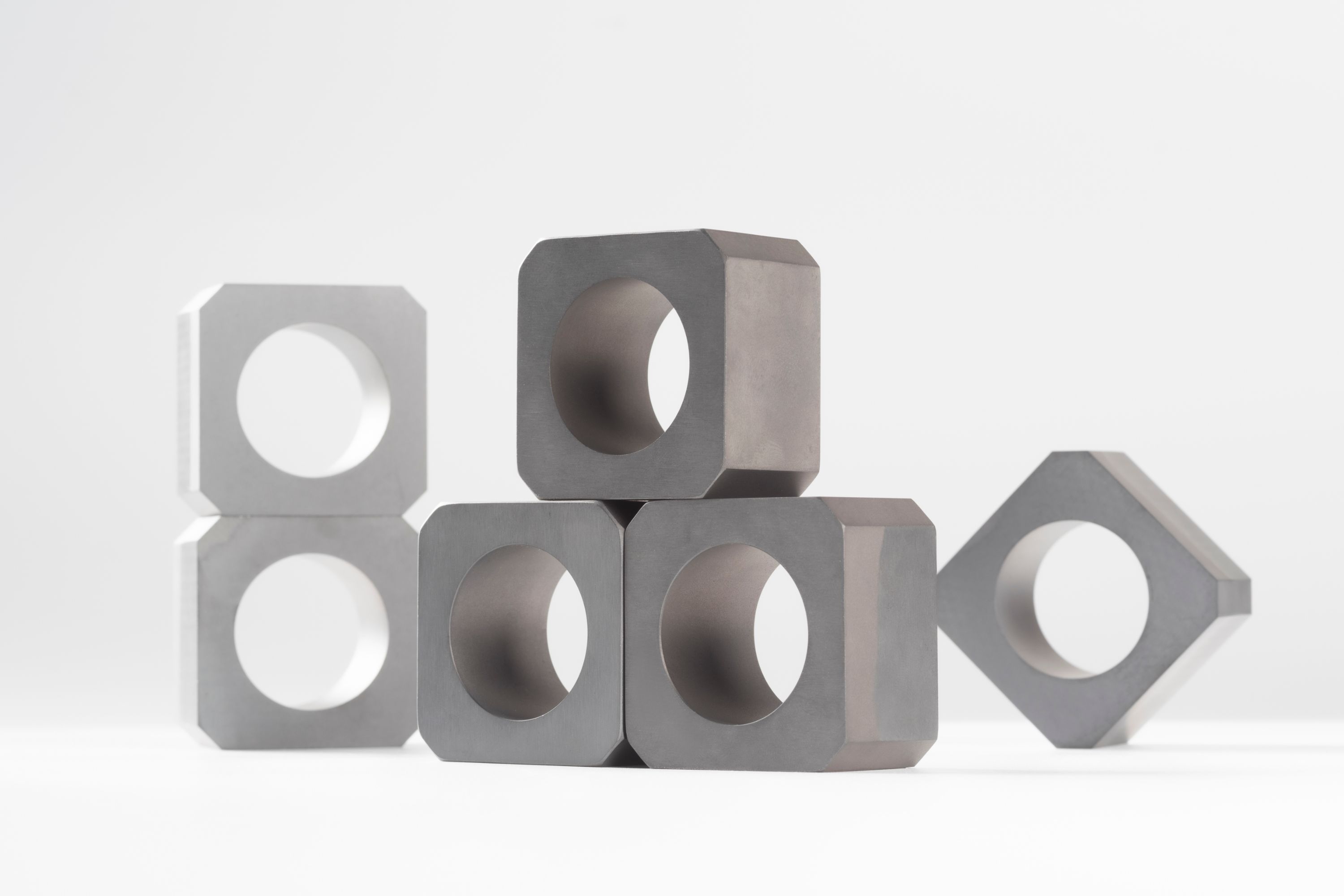
In abrasive waterjet cutting, the nozzle is where all the kinetic energy gets focused into a coherent, high-velocity stream. Poor nozzle wear doesn't just reduce cut quality—it changes the jet structure, widens the kerf, and forces operators to compensate with slower feed rates. Boron carbide stands out here because it sits just below diamond on the hardness scale, yet costs a fraction of solid diamond or even diamond composite nozzles. That combination keeps the mixing tube bore round and true for hundreds of hours, even with garnet abrasive flowing through at 600 m/s.
The real advantage shows up in precision work. A boron carbide nozzle maintains its orifice geometry long after tungsten carbide has started to bell-mouth, so the stream stays collimated and the cut edge remains square. Shops that switch typically notice fewer taper issues on thick plate and less edge frosting on delicate materials like glass or titanium. When you pair that with proper abrasive metering, the nozzle pays for itself through reduced downtime and fewer rejected parts long before it needs replacement.
Maintenance is also simpler than many assume. Boron carbide is brittle, so the nozzle must be handled carefully during installation and cleaning, but it does not require the same cooling or lubrication regimes as some exotic materials. A quick visual inspection under a loupe will reveal whether the bore is still sharp. Replacing nozzles on a schedule based on measured wear rather than sudden failure is the most reliable way to hold tolerances in production.
Nuclear Shielding: Boron Carbide's Quiet Role in Reactor Safety
Inside a nuclear reactor, neutrons ricochet at speeds that would tear through most materials like paper. Controlling them isn't about brute force, it's about absorption. Boron carbide steps in as the silent workhorse, capturing thermal neutrons without fanfare. Its atoms act like microscopic nets, snagging particles that would otherwise trigger runaway chain reactions. Unlike other shielding options that degrade into brittle shells over decades, this ceramic maintains its grip even as radiation gnaws at its structure year after year.
The real magic lies in how little of it you need. A thin plate of boron carbide can outperform a thick concrete wall when it comes to stopping certain neutron energies. That weight savings ripples through reactor design, allowing tighter fuel assemblies and leaner containment vessels. Engineers don't have to overbuild every support beam just to carry the shield's mass. Instead, they can place precision plates exactly where the neutron flux peaks, leaving other areas free for instrumentation or coolant channels.
But here's what rarely gets mentioned: boron carbide's role shifts depending on the reactor type. In boiling water reactors, it sits inside control rods as pellets, ready to drop into the core within seconds. In spent fuel pools, it lines storage racks as a passive guard, working without pumps or power. The ceramic doesn't rust, doesn't burn, doesn't complain about decades spent in a bath of demineralized water. That quiet durability is precisely why so few safety reports focus on it, when something never fails, people stop asking questions.
Lapping and Polishing: Achieving Mirror Finishes with Boron Carbide Powders
Boron carbide powders bring a distinct edge to lapping and polishing tasks where hard, brittle materials refuse to cooperate with softer abrasives. The grains fracture into sharp, angular fragments under pressure, which keeps cutting action consistent instead of glazing over. That self-sharpening behavior matters when you chase a true mirror finish on tungsten carbide, ceramic seals, or hardened tool steel.
Getting the surface from cloudy to reflective depends as much on sequence as on the powder itself. Start with a coarser grade, often 20 to 40 microns, suspended in an oil- or water-based carrier, and let the lap rotate at moderate speed. As the scratches become uniform, step down through finer sizes, rinsing thoroughly between grades to prevent stray particles from ruining the finish. The final pass with submicron boron carbide can produce a nearly featureless surface, but it requires patience and a clean workspace.
One practical trick is to watch the slurry consistency. Too thick and the powder rolls instead of cuts, leaving pits and uneven gloss. Too thin and the lap grabs, generating heat that can warp the workpiece. A well-conditioned lap, paired with a gradual reduction in particle size and pressure, usually yields that liquid-metal shine without resorting to diamond paste.
Aerospace Components: Building Lighter, Tougher Structures with Boron Carbide
Aerospace designers keep returning to boron carbide for a simple reason: it offers stiffness and hardness at a fraction of the weight of most metals. With a density around 2.5 g/cm³, boron carbide is lighter than aluminum yet sits just below diamond and cubic boron nitride on the hardness scale. That unusual pairing means structural components can shed kilograms without giving up resistance to wear, abrasion, or high-rate impacts. In practice, boron carbide appears in cockpit armor panels, helicopter seat inserts, and leading-edge strips on rotor blades—places where every gram counts and failure is not an option.
The material also earns its place in hotter, faster sections of an airframe. Unlike many polymer composites that soften beyond 150°C, boron carbide maintains strength and dimensional stability well past 400°C in inert atmospheres and resists oxidation better than most non-oxide ceramics. This has made it useful for thermal protection tiles on experimental hypersonic vehicles and for nozzle throat inserts in small thrusters. Engineers have also used boron carbide-reinforced aluminum matrix composites for satellite struts and optical benches, where low thermal expansion and high specific stiffness prevent misalignment during orbital temperature swings.
Producing boron carbide parts is still a specialist's task. The ceramic is brittle and extremely difficult to machine, so manufacturing leans on near-net-shape routes like hot pressing, pressureless sintering, and spark plasma sintering. These techniques allow complex brackets, tiles, and rings to be formed close to final dimensions, reducing costly diamond grinding. Recent work with binder jetting and other additive methods hints at more design freedom, but the real advantage comes from combining boron carbide with ductile metal phases. That approach lets the material absorb strain without catastrophic fracture, opening up uses in structural joints and load-bearing fittings that were once reserved for titanium or steel.
Industrial Wear Parts: Boron Carbide Liners That Outlast Tungsten Carbide
In high-abrasion environments, the choice of liner material dictates how often you shut down for replacement. Boron carbide brings a hardness of 9.5 on the Mohs scale—second only to diamond and cubic boron nitride—while tungsten carbide typically sits around 9.0. That gap might look small, but in sliding wear with hard particulates it translates into a measurable jump in service life. Plus, boron carbide is about one-fifth the density of tungsten carbide, so liners weigh far less and put less strain on supporting structures.
Field reports from slurry handling, shot blasting, and pneumatic conveying show boron carbide liners lasting two to three times longer than tungsten carbide in the same positions. In some alumina slurry pumping circuits, the gap widens to over five times. The material resists both abrasive gouging from sharp particles and the erosive impact of high-velocity streams. Because it holds its surface finish longer, there is also less drag and fewer hotspots that accelerate wear locally.
The initial cost of boron carbide liners can run higher per kilogram, but the math shifts quickly when you account for fewer changeouts, reduced labor, and less unplanned downtime. Many users find that a switch pays for itself within the first maintenance cycle. Custom profiles are available, including curved segments and pipe bends, so retrofit into existing equipment is usually straightforward. For operations tired of frequent tungsten carbide replacements, boron carbide is worth a closer look at the next rebuild.
FAQ
Its extreme hardness combined with a very low density lets armor plates defeat high-speed projectiles while keeping the overall weight manageable for body armor and vehicle panels.
It acts as a neutron absorber in control rods and shielding, relying on the boron-10 isotope to capture neutrons and help regulate the fission chain reaction.
The material withstands the erosive force of high-velocity abrasive particles much longer than steel or tungsten carbide, which cuts down on nozzle replacement and maintenance downtime.
Yes, thin films of boron carbide can be applied to cutting tools, molds, and other components to boost surface hardness and prolong service life under harsh conditions.
It is used for orifice and focusing tubes that must endure continuous exposure to high-pressure water mixed with abrasive grit without rapid wear.
Its light weight and high hardness make it valuable for helicopter and aircraft armor, as well as for wear-prone parts in flight control mechanisms.
Boron carbide tends to be harder and lighter than alumina, and while silicon carbide is also very hard, boron carbide often delivers better performance in specific abrasive and high-impact environments.
Conclusion
Boron carbide ranks among the hardest materials ever produced, and its unusual combination of low density and extreme stiffness explains why high-performance industries keep returning to it. In ballistic armor, replacing steel or alumina plates with boron carbide cuts weight by nearly half while still stopping rifle rounds, a difference that matters for soldiers and vehicle designers alike. The same hardness shows up in abrasive waterjet nozzles, where the ceramic resists the erosive slurry long enough to hold tight tolerances in precision cutting. Nuclear engineers rely on boron carbide for a quieter job: its boron content absorbs neutrons without adding bulky shielding, helping keep reactor spaces compact and safe.
Beyond those headline uses, boron carbide powders are the workhorse behind mirror finishes in lapping and polishing, grinding away surface irregularities with controlled, repeatable results. Aerospace manufacturers turn to the material for structural components and wear-resistant inserts, where every gram saved translates into fuel efficiency and payload gains. In heavy industry, boron carbide liners and wear parts routinely outlast tungsten carbide in chutes, mixers, and other abrasive environments, reducing downtime and replacement costs. Together with additional applications in ceramic tooling, sandblasting nozzles, and refractory coatings, these uses form a top ten list that underscores boron carbide's versatility. It is not a single-trick ceramic; rather, it quietly enables performance gains across sectors where heat, impact, and erosion would quickly destroy lesser materials.
Contact Us
Contact Person: Junting Leo
Email: [email protected]
Tel/WhatsApp: +86 18615009766
Website: https://www.huayimaterial-china.com/