

Professional Power Line Inspection Drone Simulator: Train for Safer Grid Operations
2026-09-01
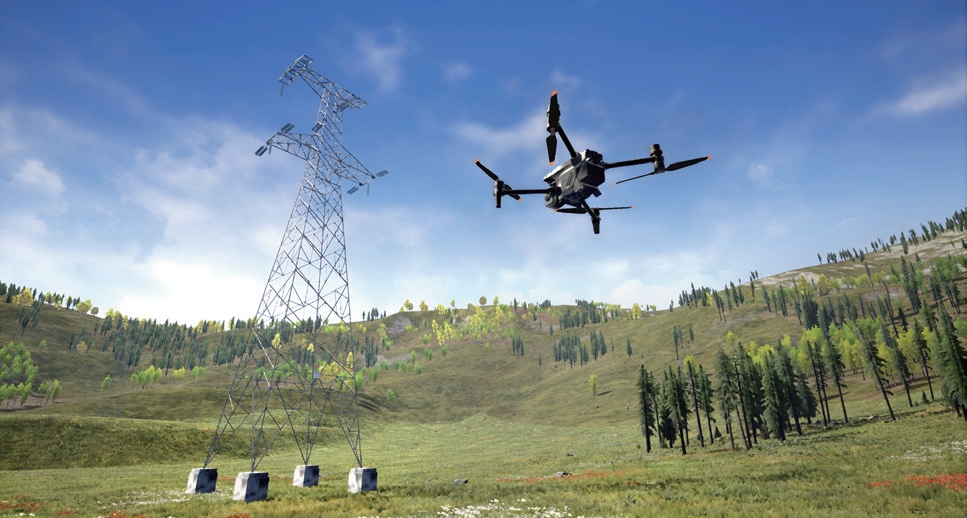
Power line inspection demands precision—one wrong move near live wires can be costly. That's why a professional drone simulator isn't just a tool; it's a lifesaver for training. With SRIZFLY, operators can practice high-stakes grid missions without the high stakes, building muscle memory for safer, smarter inspections from day one.
Gusting Winds and Drooping Conductors Shape Realistic Flight Physics
In real-world low-altitude flying, the air is rarely still. Gusting winds can shift direction and intensity within seconds, creating turbulence around poles, trees, and uneven ground. A physics model that treats wind as a fixed vector misses these transient pressure differences. Instead, realistic flight simulation samples gust fronts as localized bursts that roll across the terrain, forcing lift and drag to fluctuate even when the aircraft holds a steady attitude. This makes hovering and slow forward flight feel less like a scripted motion and more like managing an unpredictable but readable airflow.
Drooping conductors add another layer. Overhead lines sag between support towers, and their curvature changes with temperature, ice load, and current. That sag is not just a visual detail; it shapes the wake and updraft zones beneath the wires. When a small aircraft or drone flies near a conductor, the air displaced by the line curls around it and creates a narrow band of disturbed flow. If the conductor sags lower on a hot day, that disturbed band shifts downward, and a flight path that was clear in the morning may suddenly put the aircraft in turbulent air. Modeling this means the line is not a rigid cylinder but a flexible curve whose position and airflow footprint respond to environmental conditions.
Combining both effects produces flight behavior that is harder to predict but easier to trust. A sudden gust can push the aircraft toward a sagging conductor, while the disturbed air around the line reduces lift on one side and demands immediate correction. Pilots and autopilots learn to read the visual cues, such as the angle of the conductor and the movement of dust or leaves below, rather than relying on a clean, laminar flow. The result is a flight model where every approach feels less like a geometric corridor and more like negotiating a living, shifting airspace.
High-Voltage Scenarios Where Split-Second Decisions Matter
It's 3:14 a.m. in a trauma bay when a gunshot victim's blood pressure drops to nothing. The surgeon doesn't have time for a second opinion: if she doesn't clamp the descending aorta within the next sixty seconds, the patient bleeds out on the table. That kind of pressure doesn't come with a manual—it comes from years of drilling the worst-case scenarios until your hands move before your brain fully catches up.
On a high-frequency trading desk, a fat-finger order of ten thousand contracts hits the tape and the market starts to wobble. A junior trader glances at the senior guy, who hasn't even looked up from his screens. He's already calculating the spread, the depth, and the likely stop-loss cascade. He hits 'liquidate' five seconds before the floor gives way. The difference between a bad morning and a career-ending one is measured in milliseconds, not meetings.
Then there's the cockpit of a regional jet climbing out of Denver on a hot July afternoon. The right engine compressor stalls with a bang, the aircraft yaws hard, and the captain's hand is already on the thrust lever. He has maybe four seconds to decide: attempt a relight at low altitude, or trade speed for altitude and aim for the one flat field between two housing developments. He chooses the field, and everyone walks away. No debrief can fully capture why that choice was right—only that it was.
Emergency Maneuver Drills That Carry Zero Risk
Most people assume that practicing emergency maneuvers means putting yourself in harm's way, but a handful of drills can be done with absolutely no risk to you or your vehicle. Start with the parking-lot swerve-and-recover exercise: set up a few soft cones or empty cardboard boxes in a wide open space, drive toward them at no more than 10 mph, then make a smooth, controlled lane change at the last moment. Because the obstacles are lightweight and the speed is low, even a botched attempt results in nothing more than a toppled box. Repeat this until the steering input feels natural, and you'll build muscle memory for real-world evasive action without ever leaving first gear.
Another zero-risk drill focuses on threshold braking in a straight line. Find an empty stretch of road with no traffic, accelerate to about 20 mph, then press the brake pedal firmly and progressively until the car comes to a complete stop. The key is to feel the point just before the anti-lock system kicks in—or, in older cars, just before the wheels lock. Since you're moving slowly and in a straight line, there's no chance of losing control, yet you'll learn exactly how much pressure your brakes can take. Do this ten times in a row, and you'll be amazed at how much more confidently you can stop in a real emergency.
Finally, practice the "look where you want to go" drill using nothing more than a painted line in a parking lot. Drive alongside the line at walking speed, then deliberately drift toward it while keeping your eyes fixed on a point far ahead where you want the car to end up—not on the line itself. Your hands will instinctively correct the steering to avoid crossing the line, proving that target fixation is the real enemy in emergencies. This drill costs nothing, risks nothing, and rewires your brain to steer away from hazards instead of into them.
Precision Hovering Repetition Near Energized Lines
Maintaining a stable hover inches away from live conductors demands more than steady hands—it requires an almost subconscious read of wind gusts, rotor wash, and the subtle electromagnetic influence on the aircraft's flight controls. Operators often describe the moment as a quiet negotiation with the air itself, where every correction is measured in millimeters and executed before the drift even becomes visible.
Repetition transforms this high-stakes maneuver into muscle memory, but the learning curve is steep. Each pass teaches a new lesson: how rotor downwash behaves near a bundled phase, what happens to pitch authority when the tail swings toward a steel tower, or why the third consecutive hover feels different from the first as battery weight shifts. Errors are not erased but absorbed, sharpening the instinct to anticipate rather than react.
Practical training on de-energized mock-ups only goes so far. The real challenge near energized lines is the invisible—induced currents that nudge sensors, the faint ozone tang that signals proximity, and the psychological weight of knowing a single lapse could arc across the gap. Skilled crews learn to trust their peripheral vision and the aircraft's vibration signature more than any checklist, until precision hovering becomes less a task and more a state of heightened awareness.
A Structured Climb from First Hover to Full Circuit Patrol
Learning to manage a hover feels less like a lesson and more like a negotiation with the air. The skids get light, the machine starts drifting, and every correction you make arrives half a second too late. But the sequence that works is oddly simple: look far ahead, relax your grip, and let the pedals do their job. Repeat that enough times and the hover stops being a crisis.
Once the hover settles into muscle memory, the next step is moving off without letting the tail swing. Pick a reference point, lift into a low taxi, and keep the speed just below where the helicopter wants to climb. It is unglamorous work but it does something important: it teaches you how the aircraft talks back through the controls before you commit to real altitude.
The full circuit patrol brings all of it together. Climb to a sensible height, fly a rectangular pattern with deliberate turns, and manage airspeed, altitude, and lookout at the same time. The first few circuits feel overloaded, but gradually the checks become a rhythm. That is the real climb, not from hover to circuit, but from reacting to anticipating.
Immediate Telemetry Feedback That Mirrors Field Consequences
When a technician adjusts a parameter in the control panel, the readout doesn't just show a number ticking up or down. It shows what that change would do to the system if it were live—pressure spikes, temperature drift, actuator lag. The feedback arrives in the same moment as the action, so the operator feels the weight of the decision before it becomes permanent.
Instead of generic alerts or delayed reports, the telemetry stream reproduces the exact chain of events that would unfold in the field. A slow valve closure triggers a visible drop in flow rate downstream, followed by a subtle vibration signature on the pump housing. The trainee or engineer learns to associate control inputs with realistic outcomes, building muscle memory that transfers directly to on-site work.
This approach turns abstract data into a physical narrative. The dashboard isn't a spreadsheet of values; it's a live mirror of consequences. Operators start to read the telemetry the way a pilot reads instruments—not just watching numbers, but anticipating failures, recognizing patterns, and correcting course before the system lets them feel the full cost of a mistake.
FAQ
It lets trainees practice navigating drones near high-voltage lines, checking insulators, conductors, and towers without risking real equipment or personnel.
By allowing repeated practice of emergency procedures and hazard recognition in a controlled virtual environment, workers build muscle memory and confidence before facing live infrastructure.
Yes, it includes adjustable wind, rain, fog, and varied landscapes like mountains or urban corridors, so operators can experience challenging scenarios.
Utility companies, drone pilots in training, and inspection teams looking to reduce downtime and improve accuracy during power line surveys.
The system provides detailed post-flight reports on flight path efficiency, missed defects, and compliance with safety distances, helping instructors pinpoint areas for improvement.
Yes, multiple trainees can coordinate in the same virtual airspace to practice handovers, communication protocols, and multi-drone inspection missions.
By replacing expensive field training hours with virtual repetitions, organizations cut fuel, maintenance, and risk-related expenses while still achieving high proficiency.
Not necessarily. The simulator includes guided tutorials from basic controls to advanced inspection techniques, making it suitable for both novices and experienced pilots.
Conclusion
In this simulator, the usual drone training script is thrown out. You don't get calm skies or straight-line missions. Instead, you're placed inside gusting winds that shove your aircraft sideways while sagging conductors droop into frame, forcing you to constantly correct throttle and yaw just to hold a stable hover. The physics feel deliberate—no arcade shortcuts—so every dip and drift carries weight. High-voltage scenarios appear without warning: a line snaps in a storm, a tower reports an anomaly, and your split-second decision determines whether you climb, hold, or back away. Emergency drills play out exactly like that, only here the crash is a data point, not a damaged drone or an injured worker. You can rehearse a blade strike, a loss of GPS, a sudden gust near live wires, and then reset. It's repetition without consequence, which oddly makes you more honest about your mistakes.
The training path itself is built for slow competence. Early sessions have you grinding precision hovering repetitions just meters from energized lines until the controls stop feeling like inputs and start feeling like extension. Then the curriculum widens: first a full circuit patrol, then night operations, then coordinated multi-drone sweeps. The telemetry doesn't cheer you on; it mirrors what would happen in the field. A rough landing degrades your simulated battery health. A near-miss logs a stress spike. A hard yaw shows in your motor temperatures. That feedback loop—immediate, unflattering, and specific—changes how you fly the next session. By the time you exit the final module, you've internalized a simple truth: in grid inspection, the safest pilot is not the one who never encounters trouble, but the one who has already made every dangerous mistake in a place where it costs nothing.
Contact Us
Contact Person: Niles Liu
Email: [email protected]
Tel/WhatsApp: 8619945009803
Website: https://srizfly.com/