

OEM Stainless Steel Lag Bolts: What Engineers Need to Know Before Ordering
2026-10-27
Stainless steel lag bolts look straightforward—until a small mismatch in alloy or thread pitch turns a routine assembly into a field failure. Engineers ordering OEM fasteners often overlook details like passivation, head marking, and tolerance stack-up, only to discover problems after installation. Wanluo has helped customers avoid those surprises by asking the right questions early. This guide breaks down what you need to know before ordering OEM stainless steel lag bolts, so your next project can move from spec to production without expensive detours.
Why 316 Stainless Outlasts 304 in Chloride-Rich Environments
The key difference between 304 and 316 stainless lies in their molybdenum content. While 304 contains no molybdenum, 316 typically includes 2–3%, which dramatically improves its resistance to pitting and crevice corrosion caused by chloride ions. In environments like coastal areas, swimming pools, or industrial settings where salt is present, chlorides attack the passive oxide layer on stainless steel. The molybdenum in 316 helps rebuild and stabilize that layer much faster, preventing the tiny pits that eventually lead to structural failure.
This advantage becomes most apparent over years of exposure. Equipment made from 304 in chloride-rich conditions often shows rust staining and small perforations within a few seasons, whereas 316 components remain smooth and intact. For marine hardware, chemical tanks, or food processing lines that use brine, the higher upfront cost of 316 is offset by far lower maintenance and replacement expenses. Choosing 316 up front avoids the slow degradation that quietly shortens the service life of 304.
Thread Pitch Mismatches That Derail Field Installation
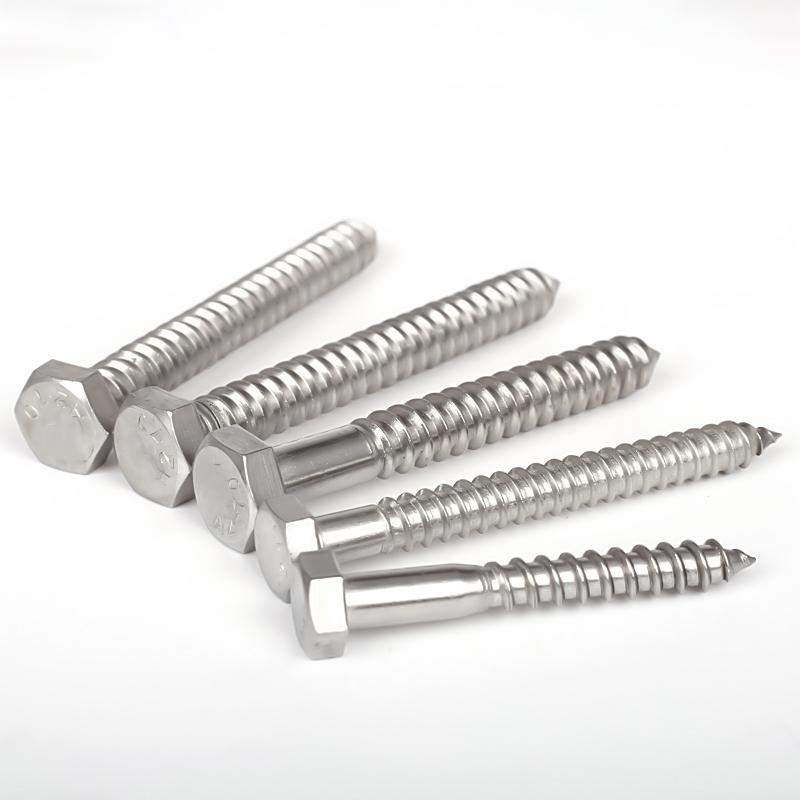
A fastener can slide into the first few threads with barely any resistance, giving a false sense of compatibility. That moment passes fast. Once the pitch angle starts fighting the mating part, the bolt or fitting binds, the hex corners round off, or the internal threads strip before the assembly even reaches torque. The mismatch is rarely obvious from the outside because coarse and fine threads can share a similar major diameter, yet the axial advance per revolution differs by enough to cause immediate galling or cross-threading.
Field crews often discover the problem only after a hydraulic fitting, pipe flange, or structural anchor has already been partially driven. At that point, backing out the fastener usually drags metal shavings into the joint, contaminates seal surfaces, or leaves a damaged thread that won't hold the next fastener either. In remote installations, that single wrong-thread part can stop an entire shift while someone searches for a tap, a die, or a replacement assembly that was never planned for.
The practical fix is less about memorizing thread charts and more about eliminating guesswork at the point of use. Marking bins with actual pitch values, keeping pitch gauges attached to tool kits, and staging look-alike fittings in separate, labeled containers prevents most mix-ups before they reach the wrench. When a fastener doesn't spin freely by hand after two full turns, the rule has to be simple: stop, back it out, and verify the pitch instead of forcing it.
Head Geometry and Drive Style: Torque Transfer Without Cam-Out
The shape of a fastener recess does more than accept a driver—it dictates how much torque reaches the thread before the driver slips or jumps. Shallow tapered geometries like Phillips rely on angled flanks that produce an axial ejection force under load. Once that force exceeds the operator's downward pressure, the bit climbs out of the recess, a failure known as cam-out. It isn't a sign of poor technique alone; it's built into the geometry.
Deeper, straight-walled recesses change the equation. Hex and Torx profiles transmit torque through nearly vertical driving faces, so the rotational force stays parallel to the driver axis instead of pushing it upward. The result is less need to lean on the tool and a firmer, more predictable engagement. Robertson square drives take a similar approach, holding the bit securely even without magnetic assistance.
Drive style also influences how a joint feels during assembly. A well-matched bit and recess produce a solid, almost snap-like seating, while a worn or mismatched pair will chatter and round off corners. Choosing a geometry that resists cam-out means fewer stripped fasteners, cleaner installations, and more consistent torque readings from start to finish.
When Hydrogen Embrittlement Threatens High-Strength Fasteners
A high-strength bolt that snaps days after tightening, with no visible yielding and barely any load applied, often leaves engineers chasing the wrong cause. In many cases, the real culprit is hydrogen embrittlement. Hydrogen atoms, absorbed during cleaning, plating, or service exposure, migrate to regions of high tensile stress. Once enough hydrogen accumulates near grain boundaries or inclusions, the steel loses its ability to deform locally, and a brittle crack can start at a stress far below the rated tensile strength.
The problem is especially acute for fasteners with hardness above roughly 39 HRC, including many Class 10.9 and 12.9 bolts. Acid pickling, electroplating, and even corrosion from a damp service environment can introduce hydrogen. What makes it dangerous is the delay: failure may occur hours or days after installation, long after torque checks have passed. Because the fracture surface often shows intergranular features and little necking, it can be mistaken for a material defect or overload, but the root cause is usually process-related hydrogen uptake.
Reducing the risk starts before plating, not after. Specifying mechanical plating or zinc flake coatings instead of acid electroplating cuts hydrogen exposure. If electroplating is unavoidable, baking the fasteners at 190–220°C within a few hours of plating helps drive out diffusible hydrogen, but it is not a guarantee if the base metal already has high residual stress or if baking is delayed. Lowering core hardness through proper tempering, avoiding over-pickling, and using barrier coatings all give a wider safety margin. For critical joints, some teams also switch to lower-strength fasteners or use vacuum cadmium or IVD aluminum, accepting a trade-off between clamp load and long-term reliability.
Quality Certs and Lot Traceability: What Your Auditor Expects
Auditors don't just want to see a binder full of certificates. They want to know those documents connect directly to the materials in your facility. If you store a coil of steel that came in three months ago, can you trace it back to the mill's test report and the certificate of conformance without digging through filing cabinets? That linkage is what separates a quality system that lives on paper from one that works on the floor.
Lot traceability expectations vary by industry, but the core question remains the same: can you show exactly which lot or batch each raw material, component, or finished product belongs to, and can you pull up the corresponding quality cert on demand? Auditors may pick a random part number from your inventory and ask you to run the trace. If your system takes more than a few minutes to respond, you'll likely get a finding.
One practical approach is to tag or label every incoming lot with a unique identifier that matches the supplier's certificate number. Then log that identifier in your ERP or quality database at receiving. When the auditor asks to see lot 47's cert, you search the database, print or display the PDF, and also show where that lot was used in production or shipped to customers. This bidirectional trace—from cert to product and product back to cert—is what auditors are really checking for.
MOQ and Lead Time Realities for Custom OEM Orders
Custom OEM orders rarely come with the friendly, low minimums you see on retail catalogs. Most factories set MOQs based on raw material procurement, machine setup time, and the simple fact that short runs eat into their margins. For a product that needs custom tooling, expect the MOQ to climb quickly—often into the thousands—because the upfront engineering cost has to be spread across enough units to make sense.
Lead times tell a similar story. A standard item might ship in days, but once you tweak dimensions, add a logo, or switch materials, the clock resets. Tooling alone can take two to six weeks before a single sample comes off the line. Then there's sampling, adjustments, and pre-production verification. Realistically, a custom OEM order from final drawing to ready-to-ship goods often spans 45 to 90 days, and that's assuming no major revisions.
Smart buyers treat these numbers as variables, not walls. Negotiate by offering longer production windows, flexible payment terms, or committing to a rolling forecast. Sometimes a factory will lower the MOQ if you accept a higher unit price or use existing molds. And when lead time is tight, ask about split shipments or partial deliveries—many suppliers can produce a first batch sooner than the full order if you plan for it.
FAQ
Most suppliers stock 304 and 316 stainless. 304 works fine for general indoor or mildly corrosive environments, while 316 holds up better around chlorides, marine exposure, or chemical processing. If the application involves saltwater or frequent washdowns, specify 316 from the start.
Yes, depending on the supplier's capability. Many off-the-shelf lag bolts follow commercial tolerances, but OEM work can hold tighter control on thread pitch diameter, shoulder length, and under-head fillet if you provide drawings. Confirm whether the manufacturer can hit the tolerances you actually need before committing.
Don't assume standard thread lengths will match your application. For lag bolts, the threaded portion is often only part of the overall length. Provide the total length and the required thread length from the point, and clarify whether partial threads are acceptable or you need full threading.
Hex washer heads are common and give good bearing surface, but if the bolts are visible, consider a clean hex head or even a custom head profile. Discuss how the head will be finished because sharp edges, burrs, or inconsistent marking can stand out on visible hardware.
They don't need protective plating like carbon steel, but passivation is often recommended to remove free iron and enhance corrosion resistance. Some applications also benefit from electropolishing for a smoother, brighter finish and easier cleaning.
Many manufacturers can produce non-catalog sizes, but minimum order quantities and lead times may increase. It's usually faster and cheaper to adapt to a nearby standard size, so weigh that before locking in a custom dimension.
Ask for material test reports showing the actual grade chemistry, and if load performance is critical, request proof load or torque-to-failure data. For structural or regulated applications, request documentation that the bolts meet the relevant consensus standard for lag screws in your region, and don't accept a generic certificate without traceability.
Stock parts can ship in days, while OEM custom work often runs several weeks to months depending on tooling, finishing, and order size. Confirm whether the manufacturer holds blanks or needs to source raw material, because that can add substantial time.
Conclusion
Specifying OEM stainless steel lag bolts demands attention to corrosion mechanisms and dimensional details that generic fasteners often ignore. In chloride-heavy environments—coastal air, de-icing salts, industrial washdowns—316 stainless outperforms 304 because molybdenum resists pitting and crevice attack far better. But even the right alloy fails if thread pitch doesn't match the mating component; mismatched pitches can cross-thread during field installation, causing delays or stripped bosses. Head geometry and drive style are equally critical: a deep hex or Torx-plus recess transfers torque more efficiently, reducing cam-out and preserving the fastener's integrity during high-torque assembly.
Beyond geometry, engineers must evaluate hydrogen embrittlement risk when high-strength stainless grades are exposed to cathodic charging or acid pickling. Proper baking and careful plating choices mitigate this sudden, brittle failure mode. Auditors also expect full material certs and lot traceability, not just a mill test report that could belong to any heat. Serialized lots and documented chemical/mechanical results make failure investigations possible. Finally, custom OEM orders rarely ship overnight; realistic MOQs and lead times depend on cold heading capacity, secondary machining, and passivation schedules. Good suppliers will share production bottlenecks before you commit, so you can plan inventory without compromising on alloy, thread, or certification requirements.
Contact Us
Contact Person: Shane
Email: [email protected]
Tel/WhatsApp: 8613357785029
Website: https://www.wanluohardware.com