

OEM Stainless Steel Hex Self Drilling Screws for Stronger Corrosion-Resistant Connections
2026-11-27
Every fastener claims to hold, but few are still holding when moisture, salt, and constant stress enter the picture. That reality makes OEM stainless steel hex self drilling screws more than a small detail—it makes them the difference between a connection that lasts and one that quietly fails. At Wanluo, these screws are built for stronger corrosion-resistant connections, and this guide explains what to look for before your next project depends on them.
How Stainless Steel Hex Heads Keep Joints Tight in Wet and Salty Conditions
The real problem in marine or coastal settings is not just visible rust on the outside of a bolt. It is what happens inside the joint: moisture wicks into the thread clearance, salt crystals build up, and ordinary carbon steel begins to expand as it corrodes. That expansion quietly loosens clamp load long before the fastener looks bad. A stainless hex head changes that failure pattern because the material does not form the same flaky oxide scale. The threads stay dimensionally stable, so the preload you applied during assembly has a better chance of remaining intact.
Hex geometry also plays a larger role than it first appears. The six flat faces let a wrench or socket spread torque evenly, which reduces the chance of slipping and lets you reach a higher, more consistent seating torque even when access is awkward. Once seated, the head profile is less likely to round off during later inspections. In a salt-laden environment, that matters because maintenance often happens under time pressure and in poor weather, when a socket that grabs cleanly is the difference between a quick retorque and a damaged fastener.
What keeps the joint tight over time is the combination of dimensional stability, a self-healing passive film, and controlled mechanical grip. Chlorides can still attack stainless steel under the right conditions, but a properly selected grade, such as 316, resists pitting well enough for most dockside, deck, and coastal equipment applications. The joint stays quiet and solid, not because the bolt became immune to the ocean, but because the material and the head shape work together to keep corrosion from turning into movement.
What Makes the Self-Drilling Point Bite Instead of Skating
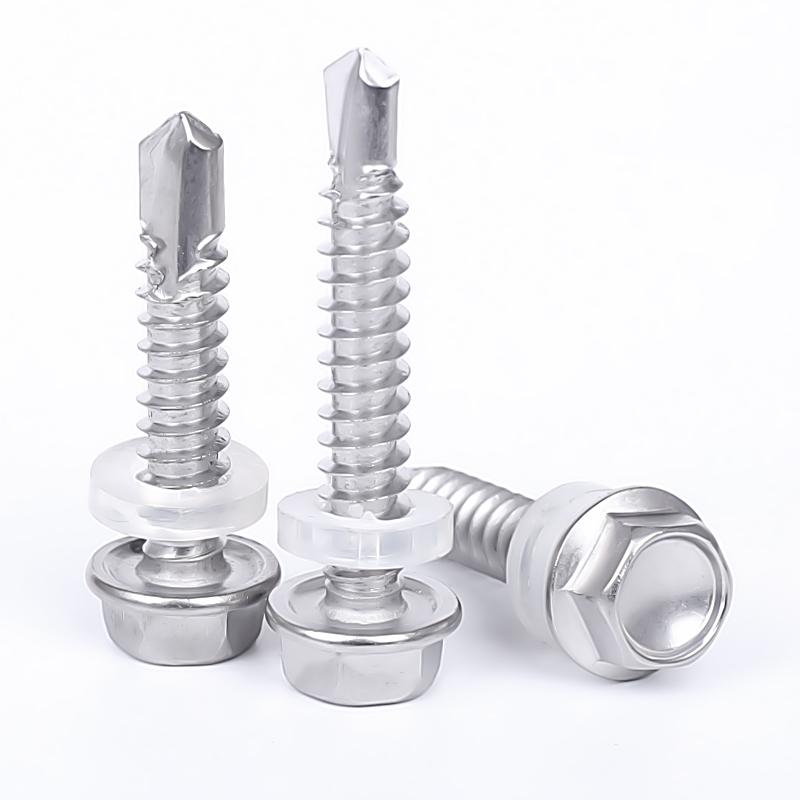
The self-drilling point gets its bite from a drill-style tip rather than a plain tapered end. There is a short flute on each side that ends in a sharp cutting edge, and the center narrows enough to put the initial load on a very small spot. When the fastener is pressed against the sheet, that concentrated pressure breaks the surface quickly, so the tip starts forming a hole instead of spinning across it.
After the first penetration, the cutting edges take over. Rotation shears thin layers of metal at the bottom of the hole, and the flutes carry the chips back toward the shank. This keeps the contact zone rough and constantly changing, which prevents the point from glazing over and sliding. The screw essentially drills its own pilot hole, so there is always fresh material for the edge to catch.
What holds it in that cutting position is the combined effect of tip hardness and early thread engagement. The point stays sharp long enough to get through the material's surface layer, and once the threads start pulling, the fastener feeds forward at a steady rate. That forward pull keeps load on the tip, which is the main reason it keeps cutting instead of skating under the pressure of installation.
Faster Assembly Without Pre-Drilling on Thin-Gauge Metal
On thin-gauge sheet metal, pre-drilling often creates more problems than it solves. The drill bit can skate across the surface, leave sharp burrs, or distort the panel before the fastener even goes in. Self-tapping and self-drilling fasteners made for light-gauge material eliminate that step entirely. The point cuts its own hole while the threads engage in a single motion, so the operator stays at the same workstation instead of switching between drill, bit, and driver. That matters most in HVAC ductwork, electrical enclosures, metal roofing, and thin automotive panels where hundreds of joints repeat across a shift.
The real advantage comes down to how the fastener enters the material. A properly matched tip geometry on steel or aluminum under roughly 3 mm will penetrate cleanly without folding the surrounding metal inward. With a steady feed pressure and the right driver speed, the screw forms a tight seat without needing a pilot hole. There’s no chip cleanup, no dull drill-bit replacement, and no second pass to align a pre-drilled hole that may have shifted during clamping. That reduction in handling is especially noticeable when fastening in awkward or overhead positions where juggling tools slows the operator down.
On a production line, taking out one step changes the pace more than it first appears. Assemblers can keep a consistent rhythm, and the work area stays cleaner because no drilling waste is produced. However, the method depends on choosing the correct fastener for the sheet thickness and base material. Too much torque will strip the newly formed threads in thin metal, so torque-controlled drivers or preset clutches are recommended. A brief trial on scrap material is usually enough to confirm the tool setting before full assembly begins.
Choosing an OEM Finish and Grade That Matches the Jobsite
Jobsite conditions rarely read the spec sheet. A finish that looks flawless in a showroom can haze, blush, or delaminate once it meets the humidity swings, slab moisture, and foot traffic of an active build. Before settling on a grade, walk the space at the hours it will actually be used. Check where the sun hits the floor, how water tracks in from exterior doors, and whether equipment wheels or steel-toe boots will concentrate wear. Those observations matter more than the product data sheet.
Grade selection should follow the same logic. Higher grades often mean fewer visible character marks, but they can be less forgiving in a busy lobby or a jobsite trailer that sees constant grit. A mid-grade material with a tougher finish sometimes outperforms a premium grade paired with a delicate coating. Match the combination to the abuse it will absorb, not just the look the owner wants in week one.
Also pay attention to cure times and recoat windows. Some OEM finishes need a narrow temperature band to cross-link properly, and rushing that step to keep the schedule moving creates callbacks later. If the site has no temporary climate control, choose a finish rated for a wider application window. The right grade and finish pair is the one that holds up under the actual rhythm of the job, not under ideal conditions.
Common Mistakes That Shorten Service Life in Corrosive Settings
A lot of equipment fails early in corrosive environments simply because the alloy selection stopped at a generic “stainless steel” note on the drawing. The actual exposure matters more than the label. Chloride levels, pH swings, temperature, and even the way condensate lingers on a surface can turn a material that works fine in one plant into a pitting problem in another. Skipping the step of matching the grade to the specific chemical mix—or choosing based on upfront cost alone—is one of the quickest ways to cut service life short.
Design details often do more damage than the environment itself. Crevices, lap joints, and water traps collect aggressive deposits and create oxygen concentration cells that eat through metal while the rest of the surface looks fine. Mixing dissimilar metals without isolation is another quiet killer: a carbon steel bracket bolted to a stainless pipe can set up galvanic corrosion that fails the cheaper part within months. Even fastener selection gets overlooked, so a perfectly good vessel ends up leaking from bolts that were never rated for the service.
Maintenance habits can accidentally strip away whatever protection the system had. Aggressive cleaning with wire brushes or chloride-heavy cleaners can destroy the passive film on stainless steel, leaving it more vulnerable than if it had been left alone. Small coating defects and early discoloration are easy to ignore until wall loss becomes obvious, but by then the repair is usually much more expensive. Regular thickness checks and a closer look at joints, drains, and shadowed areas catch the kind of gradual damage that shortens life before it turns into a failure.
A Closer Look at Thread Geometry for Stronger Material Engagement
Thread shape determines how much of the surrounding material actually works with the fastener. A thread with a steep, narrow flank tends to slice through soft substrates and leaves less bearing area behind the load, while a broader flank and a less aggressive angle spread the pull across a wider zone. Even a few degrees of change at the root can shift the failure point from the threaded hole to the fastener body, which is usually what you want in a serviceable joint.
Pitch selection matters just as much as diameter, but it gets overlooked because coarse and fine threads are often treated as interchangeable. Coarse threads leave thicker walls between adjacent grooves, so they hold better in cast or layered materials where thin sections crumble easily. Fine threads offer more contact area and clamp with less rotation, but the shallow engagement can strip in softer metals if the hole tolerances drift. The real question is whether the material around the thread can stay intact before the fastener reaches its intended preload.
Small changes to the crest and root geometry often do more than chasing a larger size. A sharp root acts like a crack starter during installation, while a small radius lets the load flow around the base of the tooth without creating a local stress spike. At the crest, a slight flat or rounded edge reduces drag and lowers the chance of galling. When these details line up with the material being used, the connection feels solid at torque, not just snug at the surface.
FAQ
Their stainless steel construction resists rust and oxidation better than standard carbon steel, especially when a grade like 316 is used in salt-heavy or coastal conditions.
Yes, the OEM approach allows adjustments to head markings, dimensions, thread form, finish, and packaging so the screws arrive ready for your product line without extra rework.
The hex head handles higher torque with less risk of cam-out, which is useful when driving into harder materials or when installers rely on socket tools on a production floor.
No, the self drilling point cuts its own hole through the base material, which reduces setup time and keeps assembly lines moving faster.
They perform well in thinner sheet metals, aluminum, and some light structural steel, though material thickness and hardness should be matched to the drill point capacity to avoid breakage.
Use moderate driving speed, steady pressure, and avoid over-tightening. A small amount of anti-seize can help when stainless steel threads make contact with stainless steel or other hard materials.
The stainless base material provides long-term corrosion resistance, but the cutting performance depends on the drill point staying sharp. If the tip burns or dulls from excessive speed, installation quality drops even though the screw body remains rust resistant.
Confirm the stainless steel grade, thread size, length, drill point capacity, head dimensions, and whether the parts need a specific passivation treatment or coating to match the application.
Conclusion
Stainless steel hex heads earn their keep in places where moisture, salt, and constant vibration would loosen ordinary fasteners. The hex flange spreads clamping force evenly, while the material's passive oxide layer keeps rust from gaining a foothold along the bearing surface and threads. Rather than skating across thin-gauge metal, the self-drilling tip carves its own pilot and taps the sheet in one pass, which removes the need to pre-drill and keeps assembly lines moving. The thread form itself is rarely given enough credit: a sharper crest and a well-placed shank slot help the fastener bite deeper into the base metal, so joints stay tight even as panels flex under load.
On a jobsite, the real difference comes from matching the OEM finish and grade to the exposure level, because not every stainless blend performs the same near chlorides or salt spray. Skipping that step leads to premature staining, crevice attack, or loosening at the worst possible time. It also helps to avoid common field errors like over-torquing, mixing stainless with carbon steel components, or reusing fasteners after the drilling point has dulled. When the grade, thread geometry, and installation habits line up, these screws deliver a stronger corrosion-resistant connection without adding extra steps or secondary coatings.
Contact Us
Contact Person: Shane
Email: [email protected]
Tel/WhatsApp: 8613357785029
Website: https://www.wanluohardware.com