

Leather Office Chair Sourcing Guide for Business Buyers
2026-10-31
Sourcing office chairs isn't just about ticking a box—it's about finding the right balance between comfort, durability, and style that your team actually wants to sit in. If leather is on your radar, you're already thinking long-term. But with so many suppliers and specs out there, where do you start? This guide cuts through the noise. And if you're exploring trusted options, keep an eye on OFCJNS—they’ve been quietly making waves among business buyers.
Leather Grades That Survive Daily Office Abuse
Most office chairs and bags stamped as genuine leather start breaking down within a year because the surface has been sanded and stamped with a fake grain. For daily desk abuse, you want full-grain or top-grain from thick hides—these retain the natural fiber structure that resists scuffs from zippers, keys, and constant shifting. Full-grain is the toughest, but a well-finished top-grain with a tight finish can handle coffee spills and pen marks better than untreated full-grain.
Skip bonded leather entirely unless you enjoy peeling armrests. If the label says split leather or leather match, expect cracking along the seat edges within months. A good test: press your thumbnail into an inconspicuous spot. It should leave a faint crease, not a permanent dent. For office wear, semi-aniline or pigmented top-grain offers the best balance—less maintenance than raw full-grain, but still shrugs off daily abrasion.
Ergonomic Details Most Spec Sheets Miss
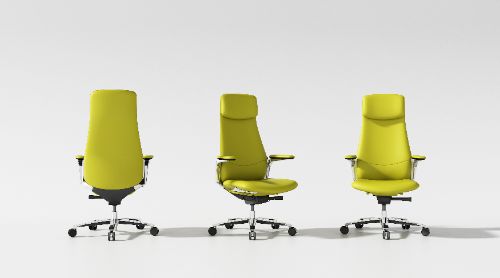
Most spec sheets stop at adjustable lumbar support and four-way armrests, but they rarely mention how those adjustments hold under real use. A lumbar dial that drifts back to flat after an hour or armrests that wobble sideways when you lean on them cancel out the benefit of having the feature in the first place. What you want is incremental tension that stays put, not just the ability to move something once.
The angle between the seat pan and the backrest is another quiet dealbreaker. Chairs that recline as one fixed shell force your hips to open and your feet to leave the floor, shifting pressure to the backs of your thighs. Look for a seat that can tilt independently and let you keep your knees slightly below your hips without a constant fight against the mechanism. Even better if the backrest follows your spine’s curve rather than pushing your shoulders forward.
Materials matter in ways spec sheets translate poorly. Two chairs can list 'high-density foam' and 'mesh back,' yet one will have a front edge that digs into your hamstrings and a mesh that sags after six months. Run your hand along the underside of the seat front—rounded, forgiving contours usually mean someone actually thought about circulation. And pay attention to fabric over cushioning: stiff upholstery creates hot spots that soft foam can’t fix.
How to Spot Weak Frame Construction Before You Buy
Start with the welds, because that is where weak frames usually fail first. Run a finger along each joint and look for uneven bead width, undercut edges, or tiny pinholes that indicate trapped gas during welding. A solid frame will have smooth, consistent welds with no sharp splatter or grinding marks covering up mistakes. Pay extra attention to high-stress areas like the bottom bracket shell, head tube junction, and rear dropouts, since these take the most abuse. If you see rust bleeding from a weld or paint flaking around a joint, that is often a sign the connection has already started to flex and crack under load.
Next, give the frame a firm shake in a few directions. Hold the seat tube with one hand and the head tube with the other, then twist. A well-built frame should feel rigid and resist the torque without creaking or noticeable deflection. If you can feel the two ends moving independently or hear a faint ticking sound, the tubes may be too thin or the joints poorly brazed. You can also tap the main tubes with a coin or key: a dull thud suggests uniform wall thickness, while a higher-pitched ring or hollow sound can mean the tubing is thinner than advertised or has internal voids.
Finally, inspect how the tubes meet at the corners. Weak frames often skip proper gussets or reinforcement plates, relying instead on small tabs or minimal contact area to save weight and cost. Look for triangular brackets at the head tube, seat cluster, and chainstay bridges. If those areas are just butt-welded without any additional support, the frame will likely fatigue faster over rough terrain. Take a small tape measure and compare the down tube and chainstay diameters to other frames in the same price range; if they are noticeably slimmer, that is a strong hint the builder cut corners on material thickness.
Bulk Pricing Tactics That Keep Your Margins Healthy
Volume discounts don't have to gut your profit. Instead of offering a blanket percentage off as quantities rise, anchor your bulk tiers to actual cost savings—like reduced packaging, shipping, or handling per unit. Pass along only a portion of those savings and keep the rest as margin. This way, customers feel rewarded for buying more, but you're not racing to the bottom.
Another approach is to bundle slow-moving or high-margin items into bulk offers. If a customer wants a deep discount on your bestseller, pair it with accessories or companion products that carry stronger margins. The blended margin across the bundle stays healthy, and you clear inventory that might otherwise sit. Set minimum order quantities that make the operational overhead worthwhile, not just the revenue number look bigger.
Finally, use time-bound bulk incentives rather than permanent price breaks. A short window—like a quarterly stock-up event or a pre-order phase—creates urgency without resetting the customer's expectation of what your product should cost. When the window closes, your standard pricing stays intact, and the perceived value doesn't erode over repeated bulk purchases.
Warranty Clauses That Could Leave You Unprotected
A warranty that proudly claims to cover 'all parts' might sound reassuring, but the details often list a long string of exclusions. Belts, hoses, batteries, and cosmetic damage are frequently carved out, meaning the very components most likely to fail are the ones you'll be paying for yourself.
Even when a covered part does fail, many warranties include a clause that disclaims responsibility for consequential damages. If a faulty capacitor ruins your motherboard, the replacement capacitor might be free, but the destroyed motherboard and any lost data are your problem.
Some manufacturers bury a requirement that you register the product within a short window—often thirty days—to activate the full warranty. Miss that deadline and your 'lifetime' guarantee quietly downgrades to a ninety-day limited one, a detail few consumers catch until they need to file a claim.
Shipping Timelines and What Actually Delays Delivery
Standard shipping timelines look straightforward on a checkout page—3 to 5 business days, 7 to 10, maybe 2-day express. But those numbers rarely account for what happens between warehouse scan and front door. A package might leave the fulfillment center on time, then sit for two days at a regional hub because a trailer isn't full enough to justify the trip.
The biggest delays usually aren't weather or holiday volume, though those get blamed often. In practice, customs clearance, incorrect address data, missed handoffs between carriers, and even the order in which trucks are loaded can add 24 to 72 hours without any tracking update. For international shipments, the gap between "departed origin country" and "arrived at destination facility" is where most packages quietly stall.
FAQ
Ask for a sample kit that includes both top-grain and bonded leather swatches, and request the factory's most recent third-party test reports for abrasion resistance and seam strength.
Look at the backing material and the grain pattern. Genuine leather has a fibrous, suede-like reverse side and irregular pore patterns, while polyurethane blends tend to have a uniform stamped texture and a fabric or foam backing.
Specify the exact leather grade, thickness, finish, and color code in the contract, and include a clause that lets you reject any future batch whose sample deviates by more than a defined tolerance.
Look for OEKO-TEX or REACH compliance on the leather, BIFMA or EN 1335 for chair durability, and GREENGUARD or similar indoor air quality certification if the chairs will be used in enclosed spaces.
Start with a pilot order of 10 to 20 chairs across different models or sizes, then scale up only after you have walked through shipping, assembly, and a 30-day in-office trial period.
Custom orders typically take 35 to 50 days for production plus 15 to 30 days for ocean freight. Lock the leather inventory before signing the contract and ask for weekly production photos to keep the factory accountable.
Yes. Import duties, port handling fees, warehouse storage, replacement covers for damaged chairs, and higher shipping costs due to the weight of leather all add up. Ask for a door-to-door quote, not an FOB price.
Conclusion
For business buyers, sourcing leather office chairs that hold up under daily abuse starts with understanding leather grades. Full-grain and top-grain options resist scuffs and wear far better than bonded or split leather, though they cost more upfront. Beyond the surface, dig into ergonomic details often missing from spec sheets: seat depth adjustment, lumbar tension that actually supports different spine shapes, and armrests that don't wobble after a few months. These small differences separate a chair your team can sit in for eight hours from one that causes complaints by week two.
Frame construction is another area where weak spots hide. Look for chairs with reinforced steel plates at the seat-to-base connection and avoid plastic brackets that crack under shifting weight. On the commercial side, negotiate bulk pricing by requesting tiered quotes based on volume and asking about freight consolidation—many suppliers will lower per-unit costs if you accept longer lead times. Always review warranty clauses for exclusions on leather cracking or gas lift failure, and clarify shipping timelines in writing, since foam production and customs clearance often cause the real delays, not the final mile.
Contact Us
Contact Person: Diff Wang
Email: [email protected]
Tel/WhatsApp: +8613650281199
Website: https://www.ofcmeshchair.com/