

Gasket Tape Manufacturers China: Top 10 Leading Suppliers
2026-08-21
When it comes to sourcing reliable gasket tape manufacturers, China stands at the forefront of global supply. But with countless suppliers claiming top quality, how do you separate the leaders from the rest? In this guide, we spotlight the top 10 leading suppliers shaping the industry—including Kaxite, a brand known for its precision-engineered sealing solutions. Whether you're an OEM buyer or an engineer seeking durable materials, the list ahead will give you a clear starting point.
Material Mastery: What Sets Chinese Gasket Tapes Apart
The material gap between ordinary and high-performance gasket tape shows up long before installation. Leading Chinese manufacturers now rely on virgin PTFE and expanded graphite with tightly controlled particle size and impurity levels, rather than recycled or blended feedstocks. This shift removes micro-voids that cause cold flow and leak paths during thermal cycling. For graphite tapes, carbon content is held at 98% or higher, with sulfur and chloride kept below 300 ppm, helping prevent pitting on flange faces in sour service environments.
Filler loading is just as deliberate. Barium sulfate, silica, and glass microspheres are not used simply to lower cost; they are calibrated to fine-tune compressibility and recovery. A well-dispersed 25% filled PTFE tape can recover 60% of its thickness after load, but a poorly mixed batch may recover only half that. That difference determines whether a gasket survives a swing from ambient to 400°F without retorquing.
The real separator is process discipline. Mixing cycles, calendering pressure, and sintering profiles are adjusted per formulation instead of running on a one-size-fits-all line. This is why gasket tapes from a handful of Chinese plants now match or exceed the density consistency of European equivalents, with sheet-to-sheet variation under 2% rather than the 5-8% common a decade ago.
Custom Profiles and Precision Cutting for Complex Sealing Needs
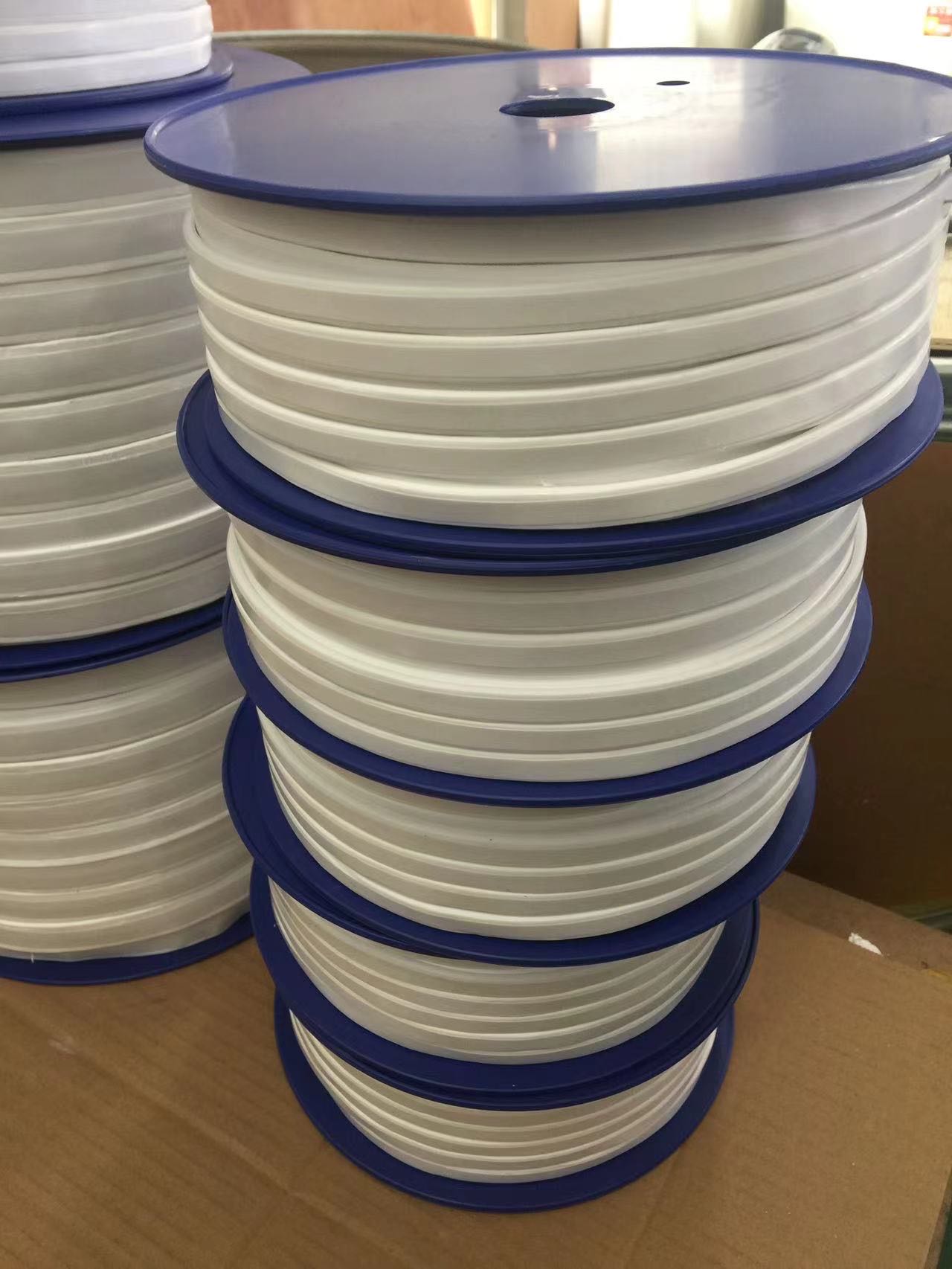
Sealing challenges rarely fit neatly into standard catalog shapes. That's where custom profiles earn their keep—by accommodating irregular grooves, angled flanges, and multi-material transitions that off-the-shelf extrusions simply can't handle. We work from your CAD or physical sample to replicate the exact cross-section, whether it's a co-extruded bulb with a rigid base or a hollow sponge profile that compresses predictably around a curved housing.
Precision cutting is just as critical as the profile itself. A seal that's cut slightly long buckles, while one cut short leaves a gap—both fail in the field. Our cutting systems handle tight length tolerances down to ±0.005 inches, with options for angle cuts, notches, and mitered corners to match complex assembly geometries. This accuracy matters most when you're stacking multiple seals or routing them around tight bend radii.
The real payoff shows up in demanding environments like automotive weather-stripping, industrial door gaskets, and medical device enclosures. Instead of forcing a standard part to fit and hoping for the best, you get a seal that follows the actual contour of your design—reducing installation time and eliminating leak paths. That's the difference between adapting to a limitation and engineering around it.
Global Compliance Without the Red Tape
Running a business across borders usually means juggling a maze of local rules, deadlines, and filing formats. But global compliance doesn't have to bury you in forms or endless email threads with overseas agents. The old way—sending the same corporate documents to five different regulators, each with their own tweaks—can now be handled by a single quiet system that knows what each country expects.
Instead of a generic checklist, the process leans on local specialists who already speak the language of each market, paired with software that fills in the right fields automatically. Your legal name, address, and board changes are entered once, then formatted for Singapore, Germany, Brazil, or wherever you operate. No re-keying, no courier packages, no waiting for a notary to wake up in another time zone.
What you end up with is a dashboard that shows upcoming filing dates, what's been submitted, and what still needs a signature—all without needing a compliance officer on every continent. The goal isn't just fewer headaches; it's knowing that your cross-border obligations are met on time, every time, without turning your back office into a paper factory.
From Batch Testing to Zero-Defect Shipments
Batch testing, where a random sample from a production run is inspected and the entire lot is accepted or rejected based on that sample, has been the backbone of manufacturing quality for decades. But it leaves a statistical gap: even a passing batch can contain defective units that slip through simply because they were not part of the sample. As customer expectations tighten, many operations are moving away from this lottery-like approach and aiming for every single shipment to be free of defects.
The shift to zero-defect shipments rarely means inspecting every product by hand. It means redesigning the production process so that defects are prevented rather than detected. Automated inspection systems, real-time process control, and machine vision can check critical dimensions, surface finish, and assembly integrity on every unit without slowing the line. When a deviation is spotted, the line stops or the unit is quarantined before it ever reaches a shipping carton.
This approach also demands a different mindset from the entire team. Instead of asking "did the sample pass?" engineers and operators ask "what could cause a single unit to fail?" Root cause analysis, supplier quality management, and continuous feedback loops become central. The payoff is more than just happier customers: fewer returns, less rework, and a reputation for reliability that batch testing alone cannot guarantee.
Lead Times That Keep Your Line Moving
Most manufacturers treat lead times as a fixed constraint, but the real opportunity lies in how you manage the gap between order and delivery. Instead of simply accepting whatever your suppliers quote, dig into where those days actually go. Often, a third of the time is spent waiting for internal approvals or chasing missing specs. Tighten those loops and you can shave days without touching a single production machine.
Short lead times sound great on paper until a single hiccup shuts your line down. The trick is to shorten your response time, not just the supplier's promise. Build a small buffer of high-turn parts, but keep it dynamic. Pair that with a schedule that can absorb a late truck without cascading into idle stations. If you only focus on squeezing vendors, you'll end up with fragile flow and more firefighting.
A practical move is to split your parts list by lead time volatility. For stable items, push for vendor-managed inventory or blanket orders with rolling releases. For the unpredictable few, keep a local safety stock and a shortlist of alternate sources. The goal isn't zero lead time; it's a line that keeps moving even when a promised date slips. That resilience is what actually separates smooth operations from constant expediting.
Scaling Production Without Sacrificing Consistency
Ramping up output usually invites shortcuts, but consistency doesn't have to be the casualty. The trick lies in building a production rhythm that treats every unit as a fresh check against the original spec, not as a photocopy of the last one. When teams stop relying on memory and start leaning on calibrated checkpoints built into the line itself, small drifts get caught before they become patterns.
Another piece is designing for variance from day one. Instead of assuming machines and people will behave identically at double the volume, you plan tolerance windows that stay realistic under load. That means regular, unannounced audits of the process rather than just the final product, and making it easy for anyone on the floor to flag a deviation without fear of slowing things down.
Finally, consistency survives scaling when feedback loops shorten. A weekly quality review becomes a daily ten-minute standup, and that standup feeds directly into the next shift's setup notes. The goal isn't perfection captured in a binder on a shelf; it's a living agreement about what "good" looks like, refreshed often enough that ten thousand units in, the tenth still matches the first.
FAQ
The industry clusters are mostly in Hebei, Jiangsu, and Zhejiang provinces. Hebei is strong in rubber-based tapes, while Jiangsu and Zhejiang have more facilities focused on PTFE and silicone materials.
You'll find expanded PTFE, silicone foam, EPDM, PVC, and butyl rubber. Many suppliers also offer blended materials to meet specific temperature or chemical resistance needs.
Request samples and test them under your actual working conditions. Also ask for third-party test reports like SGS or TÜV, and check if the factory has ISO 9001 or IATF 16949 certification if you're in automotive.
Yes, most leading suppliers have in-house slitting and die-cutting lines. You can specify width, thickness, adhesive type, and even liner color. Some also offer logo printing on the release liner.
MOQs vary widely. For standard foam tapes, it might be 500 to 1000 rolls. For specialty PTFE tape, some factories accept as low as 200 rolls, but expect a higher unit price for small batches.
Lead times are often 15 to 30 days after deposit, depending on the complexity and current production load. Customized adhesive or non-standard thickness can add another week or two.
Common uses include HVAC duct sealing, automotive door and trunk seals, electrical enclosure gaskets, and construction weatherproofing. Some suppliers also cater to marine and aerospace with high-spec materials.
Like any sourcing, you should confirm export licenses, understand Incoterms, and maybe use a third-party inspection service before shipment. Also, clarify warranty terms for defects or short quantity.
Conclusion
China's leading gasket tape producers have moved far beyond commodity supply. Their edge starts with material science: closed-cell PVC, EPDM, neoprene, and silicone foams are compounded in-house, allowing exact control over density, compression set, and temperature resistance. For demanding sealing jobs, these factories routinely build custom profiles—wedge, bulb, D-shape, and co-extruded dual-durometer strips—and pair them with precision kiss-cutting, rotary die-cutting, and laser scribing to match complex flange geometries without waste. Compliance is handled as a default rather than an add-on, with REACH, RoHS, and UL documentation bundled into the quote, so buyers skip the back-and-forth.
What keeps OEMs and distributors returning is reliability under volume. Top suppliers run automated vision inspection and tensile/adhesion tests on every batch, then quarantine full lots until lab sign-off, which effectively eliminates field defects. Their standard lead times—often 10 to 14 days for reorders and 20 to 25 days for new tooling—are short enough to prevent line stoppages, while parallel extrusion lines and CNC cutting cells absorb sudden demand spikes. Scaling from a few thousand meters to millions does not change the product, because recipes and process parameters are locked digitally and shared across sister plants. In practice, the top ten Chinese manufacturers function less like vendors and more like an extension of your own production floor.
Contact Us
Contact Person: Kaxite
Email: [email protected]
Tel/WhatsApp: 0086-574-87527771
Website: https://www.seal-china.com