

Custom Milk Production Line Solution: Designing Efficient Dairy Processing Systems
2026-11-03
Every dairy processor knows the frustration of trying to fit a square peg in a round hole. Off-the-shelf milk production lines rarely match your plant’s layout, capacity targets, or product mix. That’s where a custom milk production line solution comes in—and where INTOP Machinery has been quietly rewriting the rules of dairy processing efficiency.
Mapping Your Dairy Workflow Before a Single Pipe Is Cut
A dairy plant rarely fails because of a single bad valve or a undersized pump. The breakdowns that cost the most time and money usually trace back to a workflow that was never truly mapped before the first length of stainless pipe was ordered. Walk through any facility that has been through multiple retrofits and you will see the evidence: CIP circuits that double back on themselves, product lines crossing waste lines at awkward angles, and operators improvising hose jumps because the original design assumed a flow path that never actually happens on the floor. Mapping your workflow means sitting down with the people who run the process daily—not just the engineers—and drawing out every transfer, every recirculation loop, every manual intervention. Until that map exists on paper and everyone agrees it reflects reality, cutting pipe is just guesswork with expensive materials.
One of the most overlooked parts of this mapping phase is sequencing. Dairy processing is not a static set of connections; it is a series of timed events that overlap. A silo empties while a pasteurizer is in divert, while a separator is discharging sludge, while a cheese vat is waiting for curd. If your workflow map does not capture these overlapping states, you will end up with a pipe layout that looks clean on a schematic but creates bottlenecks the moment production starts. For example, a line sized for a single product transfer might work fine in isolation, but if that same line must also handle CIP return from three tanks at once, the velocity drops, the cleaning suffers, and suddenly you are scheduling extra wash cycles just to keep biofilms at bay. Mapping before cutting forces you to ask the uncomfortable question: what is happening elsewhere in the plant when this pipe is at full flow?
The real value of a thorough workflow map shows up years later, after the welders have gone home and the inspectors have signed off. A well-mapped dairy plant can accommodate a new product, a changed pasteurization schedule, or a different cleaning chemical regime without tearing out half the ceiling. A poorly mapped one needs a bypass hose and a prayer every time the market shifts. It is not about drawing pretty diagrams—it is about building a pipe network that matches how milk, cream, whey, and cleaning solutions actually move through the building on a Tuesday at 2 a.m. when the third shift is running behind and the separator alarm is ringing. That kind of reality cannot be retrofitted with an extra tee and a swing bend. It has to be designed into the layout before the first cut is made.
Equipment Choices That Match Your Milk Type and Volume
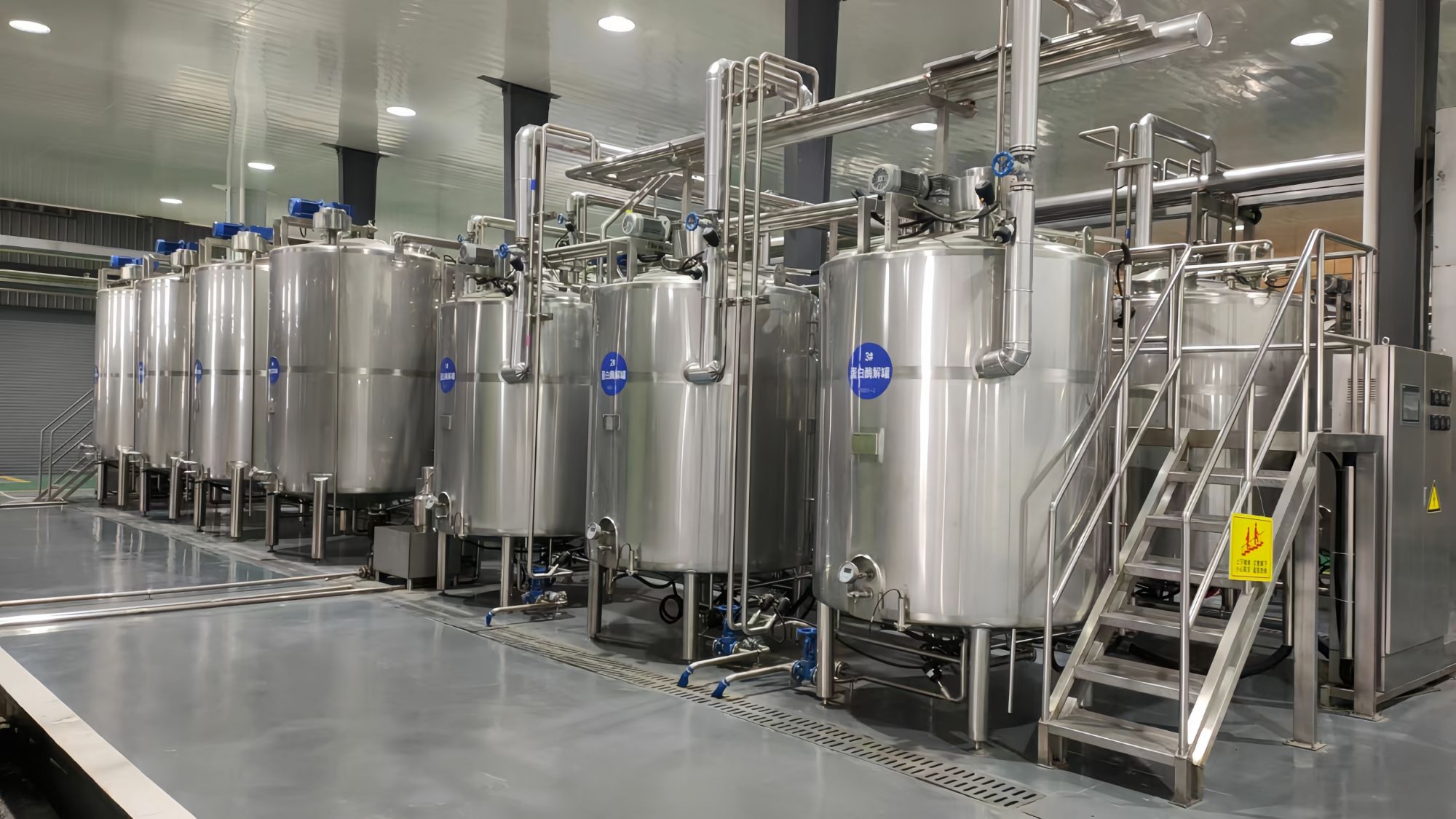
Milk fat content quietly dictates the kind of homogenizer and heat exchanger you should be eyeing. Whole milk needs a homogenization pressure around 200 to 250 bar to keep fat globules from clumping into a cream plug, while skim milk handles lower pressure but punishes you with a cooked flavor if your pasteurizer runs hotter than 72°C for the standard 15 seconds. Small-batch cheesemakers working with 100 to 300 litres a day can get away with an open vat and a hand-held curd cutter, but once you cross into larger volumes, the same milk type demands a closed vat with mechanical cutting knives and precise temperature ramps.
Volume shapes the equipment footprint more than most people expect. A 150-litre batch pasteurizer and a single draining table might handle a small farmstead operation, but push beyond 2,000 litres per day and you will need a plate heat exchanger, a balance tank, and automated cleaning cycles to avoid spending half the shift on sanitation. Oversized tanks create dead zones where milk sits too long, while undersized ones force you into back-to-back batches that wear out seals and pumps. Match the tank capacity to your largest realistic daily intake, not your optimistic five-year projection.
Plant-based milks flip the script entirely. Oat milk carries enough starch to gum up a standard homogenizer valve, so you need a high-shear mixer ahead of the line and a wider valve gap. Almond milk separates quickly without stabilizers, meaning your storage tanks should have gentle agitation and your filling line runs at lower speeds to avoid foam. Soy milk demands an ultra-high-temperature step around 135 to 140°C for a few seconds to knock out beany enzymes, equipment that makes no sense for cow's milk but is non-negotiable for a shelf-stable oat or soy product.
Energy Recovery Loops That Lower Running Costs Quietly
Heat that used to vanish through exhaust stacks now circles back into the system, pre-warming incoming air or water. This quiet recapture happens without extra fuel or moving parts that demand attention. The savings accumulate on the utility bill month after month, yet the building never feels different to the people inside.
Pressure differences that once bled energy as wasted airflow get redirected through recovery wheels and plate exchangers. These components spin slowly or sit still, trading thermal energy between outgoing and incoming streams. Because the process works passively, maintenance stays minimal and the operating cost curve bends downward without any noticeable change in daily operations.
In many facilities, the biggest efficiency gains come from loops that no one sees: condensate return lines, glycol runaround coils, or heat pump desuperheaters. Each one reclaims low-grade warmth that would otherwise be lost. Over a full year, the reduction in heating and cooling demand can reach double-digit percentages, all while the equipment hums along in the background.
Hygienic Design Details That Go Beyond Standard CIP
Standard CIP cycles handle interior surfaces well, but the hidden edges of equipment often remain a contamination risk. Instead of relying on the same spray ball coverage and flow rates accepted elsewhere, focus shifts to eliminating recesses where product can lodge. One practical move is to replace threaded fittings with sanitary clamp connections on every product-contact line, including drain ports and sample valves. Another detail that gets overlooked is the transition between tank walls and nozzles—using flush-mounted, crevice-free designs prevents biofilm from gaining a foothold. These choices reduce the need for aggressive chemical concentrations and shorten rinse times, which in turn lowers water and energy use without compromising cleanliness.
Pumps and valve bodies also harbor pitfalls beyond what a standard CIP run can address. Opt for rotors and stators with fully drainable geometries, and check that internal shaft seals are designed to be cleaned from the product side rather than trapping residue behind a lip. For mixers and agitators, look for one-piece impellers without undercuts or set screws—any small gap becomes a harbor for spoilage organisms. Even the orientation of piping matters: avoid dead legs longer than 1.5 times the pipe diameter, and slope horizontal runs to self-drain. These are not exotic upgrades; they are deliberate deviations from default configurations that make sanitation verifiable instead of assumed.
Material selection plays a quieter but equally critical role. Electropolished stainless steel with a surface roughness below 0.8 µm Ra resists protein adhesion far better than standard 2B finish, and it holds up under repeated hot caustic washes without micro-pitting. For gaskets and O-rings, move away from generic EPDM to FDA-compliant compounds with lower extractables, and design grooves so that the seal sits flush with the product contact face—no over-compression or exposed edges. When every fitting, junction, and surface profile is chosen with drainage and cleanability in mind, the plant moves from cleaning validation to cleaning certainty.
Automation Without Losing the Human Touch on the Line
Automation on the line often gets painted as a choice between cold efficiency and warm intuition, but the best setups refuse that false divide. A robotic arm may place a bracket in under a second, yet it still needs a veteran operator to notice when the weld bead smells slightly off or the vibration changes pitch. Those sensory cues don't appear in any sensor log, and they are exactly where experienced hands keep quality from slipping.
The trick is to let machines handle the repetition while preserving space for human judgment at the edges. Instead of burying workers in dashboards, some plants now use simple light signals or haptic alerts that prompt a quick manual check. That keeps the pace without numbing the instincts that come from years on the floor. Automation becomes a tool held by the crew, not a cage around them.
Training changes too. Rather than teaching people to monitor screens, line leads pair new hires with automation techs and old-timers together. The new hire learns what the system can do; the old-timer teaches what the system cannot feel. In a few months, you get operators who can troubleshoot a servo and still run a thumb along a seam to judge the finish. That blend is hard to copy, and it's the real reason some lines keep their edge.
Scaling Up Without Ripping Out What Already Works
Growing a system rarely means starting from zero. The parts that already handle daily traffic, payments, or user data have been battle-tested by real problems. Ripping them out to chase a shiny new stack often trades known issues for unknown ones. A more practical route is to treat the current system as a foundation, not an obstacle. Add new services around the edges, keep the proven core running, and only replace pieces when they actually become a bottleneck.
One underrated advantage of older code is the domain logic baked into it. Those tangled conditionals and outdated frameworks often encode years of edge cases that no one remembers anymore. Instead of rewriting from memory, wrap the legacy modules behind clean interfaces. Let new components call them like any other service, then gradually move functionality out as you build confidence. This keeps the business running while the architecture evolves in small, reversible steps.
The trick is to define boundaries early. Split the system into areas that change often and areas that rarely do. Introduce a thin compatibility layer between old and new, so traffic can shift gradually without a big-bang cutover. Monitor both paths, keep rollback easy, and let real usage guide your refactoring priorities. Scaling up then becomes a series of controlled migrations rather than a risky demolition project.
FAQ
Look closely at incoming raw milk quality, peak volume, product mix, and any existing equipment that can be repurposed. Sites with wide seasonal swings or plans for multiple SKUs often need buffer tanks and switchable pasteurization paths rather than a single rigid flow.
The pasteurizer sets the rhythm for everything downstream. Plate exchangers suit steady, high-volume work; tubular designs handle viscous or particulate products better. Matching regeneration rates and holding tube dimensions to your actual throughput avoids both energy waste and product damage.
Keep clean and soiled zones separated, minimize pipe runs between receiving, processing, and filling, and position valves so maintenance doesn't require shutting down the entire line. Gravity-assisted product transfer for low-viscosity liquids also cuts pump energy and cleaning time.
CIP is not an afterthought. The best custom lines dedicate enough flow, temperature, and chemical dosing capacity to clean every circuit without manual intervention. Designing for full drainage and using hygienic instruments that withstand thermal cycling prevents contamination and extends equipment life.
They serve different needs. Modular skids reduce on-site construction time and allow future capacity changes, but they require precise interface planning. Fully welded layouts can be more compact and customized, though later modification is harder. The decision depends on growth forecasts and site constraints.
By reducing product losses through smart recovery and proper valve sequencing, by sizing pumps and motors to avoid chronic overloading, and by selecting sensors that provide actionable data for line balancing. Small design choices, like placing sampling ports accessibly, reduce labor hours and error rates.
Underestimating cleaning time, ignoring future SKU flexibility, and treating automation as a final layer rather than as an integrated part of the design. Another common error is over-centralizing control without allowing local manual overrides for troubleshooting.
Conclusion
A sensible custom line starts long before any stainless steel is ordered. Walk the floor and map how milk actually moves—from intake and separation to pasteurization, homogenization, and filling. This early mapping catches bottlenecks and awkward transfer points that later force expensive retrofits. Once the route is clear, equipment selection becomes less about catalogue specs and more about what your milk is doing daily. A small goat dairy handling 2,000 litres needs different pump speeds, separator discs, and holding tube geometry than a cow milk plant pushing 50,000 litres of skim and whole lines. Matching capacity to real surge volumes, not theoretical peaks, keeps downstream cleanings shorter and start-ups calmer. Tucked into that same design phase are energy recovery loops—plate exchangers that return pasteurized heat to incoming raw milk, or chilled water loops that pre-cool before final glycol. These loops rarely make the front page, but they quietly shave 15 to 25 percent off thermal bills year after year.
Hygiene on a custom line goes further than putting spray balls in every tank. Drainability matters almost as much as cleanability; pipe slopes, pocket-free valve clusters, and shadowless welds stop product from sitting where CIP chemicals can't reach. Sensors placed after the final rinse tell you whether a cycle actually worked, not just that it ran. Automation then wraps around this physical layout without turning operators into bystanders. Keep manual sample ports, visible pressure gauges, and hand-operated bypass valves where they help a supervisor feel the process. When it is time to scale, the best custom lines add a second pasteurizer, a bigger separator, or an extra filler module alongside the existing train rather than replacing it wholesale. That approach keeps proven cleaning routines, spare parts stock, and operator muscle memory intact while capacity steps upward.
Contact Us
Contact Person: Laura
Email: [email protected]
Tel/WhatsApp: +86 13957758832
Website: https://www.intopmachinery.com