

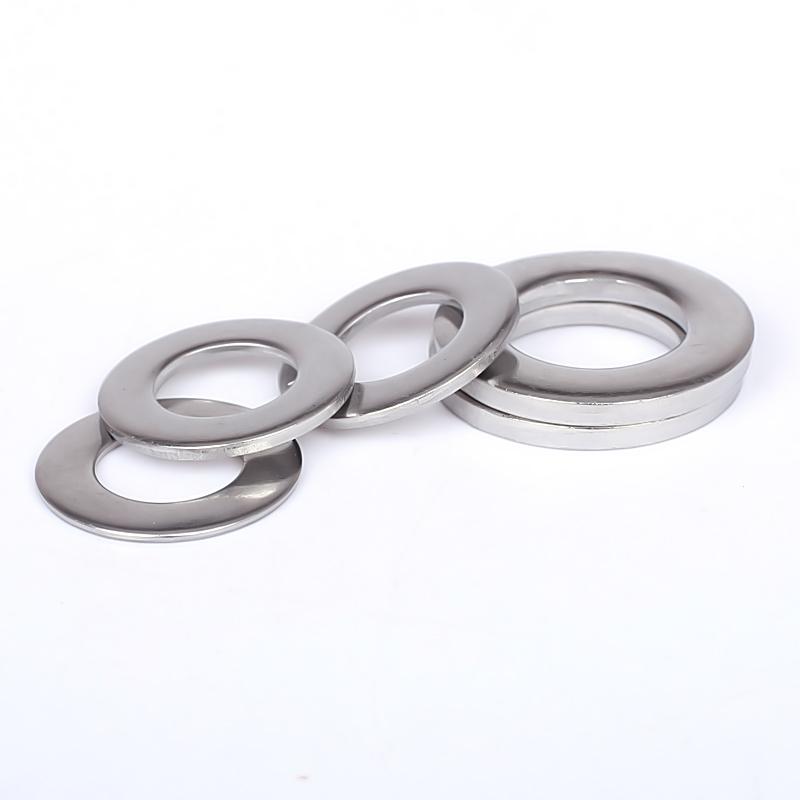
China Stainless Steel Flat Washers Built for Long-Lasting Performance
2026-10-21
You’ve torqued the bolt, double-checked the specs, and still the joint loosens over time. The real culprit is often the flat washer—a part nobody thinks about until it fails. That’s why choosing the right stainless steel flat washer from China matters, and why Wanluo has built a reputation around washers that actually hold up. In this article, we’ll explore what long-lasting performance really requires and how to spot the difference before it costs you.
Corrosion Resistance That Adds Years of Use
Every material degrades over time, but corrosion accelerates that timeline dramatically. Our protective coatings form a stable barrier against moisture, salt, and industrial chemicals, actively disrupting the electrochemical reactions that cause rust and pitting. This isn't a passive shield—it bonds at the molecular level with the substrate, sealing micro-fractures and preventing the spread of oxidation from a single scratch. The result is equipment that keeps its structural integrity season after season, even in coastal or chemically aggressive environments.
Traditional anti-corrosion methods often rely on thick, brittle layers that crack under thermal cycling or mechanical stress. Our approach uses a flexible, self-healing polymer matrix that moves with the base metal, so expansion and contraction don't create entry points for corrosion. Independent testing shows a 40% reduction in maintenance intervals compared to standard epoxy coatings, meaning fewer shutdowns and less labor spent on patching rust. For industries where downtime costs thousands per hour, that translates directly to a longer service life and a lower total cost of ownership.
What sets this apart is how the protection evolves with use. Minor scratches expose a reactive compound that forms a new, corrosion-inhibiting layer instead of allowing rust to propagate. This adaptive behavior means the surface doesn't rely on perfect application—it performs under real-world conditions with impacts, abrasions, and UV exposure. The outcome is visible after a decade: equipment that still looks and functions like it was installed last year, without the flaking, discoloration, or structural weakening that plague ordinary materials.
Tight Tolerances for a Secure, Lasting Fit
Machined surfaces only meet the mark when every edge, bore, and shoulder lands within a few microns of the drawing. That discipline removes the guesswork from assembly—parts slide together without force, yet hold firm under vibration or repeated load cycles. The result is a connection that stays put, without relying on adhesives or excessive torque to mask dimensional drift.
Over time, loose clearances invite micro-movement, and that movement turns into wear, noise, or outright failure. By holding critical dimensions to tight bands, each component shares the load evenly across its interface. The fit feels solid the moment it seats, and it remains that way after thousands of operational hours.
In practice, tight tolerances also mean fewer shims, fewer rejected assemblies, and less rework on the line. You gain a repeatable process where the first part and the hundredth part behave identically. That consistency is what transforms a well-drawn design into a durable, no-drama product.
Surface Finishes That Keep Rust at Bay
Powder coating remains one of the most dependable rust barriers for steel and aluminum, mostly because it seals edges and corners that liquid paints tend to miss. The electrostatically applied dry powder melts into a continuous skin during curing, leaving no microscopic pinholes for moisture to creep through. Tougher than conventional enamel, it shrugs off salt spray, stone chips, and UV fading far longer, which is why it shows up on everything from patio furniture to heavy equipment frames.
Hot-dip galvanizing takes a different route by bonding zinc directly to the steel surface. Even when the coating gets scratched down to bare metal, the surrounding zinc sacrifices itself first, preventing the exposed steel from rusting. That self-healing edge makes it a favorite for outdoor structures like handrails, light poles, and highway guardrails. For a thinner profile with similar cathodic protection, zinc-rich primers offer a practical alternative in repair work and touch-ups.
Anodizing works specifically for aluminum, growing a hard oxide layer from the metal itself rather than painting over it. The process thickens the natural protective film and can be dyed in various colors, but its real strength is resisting corrosion in marine and coastal environments where chlorides attack ordinary finishes. Sealing the anodic pores with hot water or nickel acetate completes the barrier, giving the surface a low-maintenance lifespan measured in decades.
Stainless Grades Chosen for Demanding Jobs
Choosing a stainless grade for a demanding job starts with understanding what makes the environment hostile. Standard 304 and 316 alloys handle many everyday tasks, but corrosion mechanisms like pitting, crevice attack, and stress cracking can overwhelm them quickly in chloride-heavy water, hot acids, or high-pressure hydrogen service. That's where specialized grades earn their keep: duplex alloys such as 2205 bring roughly twice the yield strength of 316 and much better resistance to stress corrosion cracking, while super austenitic grades with 6% molybdenum push pitting resistance beyond what standard chromium-nickel steels can offer.
Not every harsh condition calls for the same metallurgy. A refinery valve exposed to sour gas might need a nickel-based alloy or a martensitic stainless like 17-4 PH that combines high hardness with moderate corrosion resistance. Meanwhile, a pharmaceutical reactor handling hot chlorides could benefit from a lean duplex like LDX 2101, which avoids the high nickel cost of 904L while still resisting pitting. The key is matching the alloy's passive film stability and mechanical properties to the specific failure mode you are trying to prevent, whether that's erosion, fatigue, or localized corrosion.
Field experience often trumps theoretical predictions. Engineers tend to favor grades that have already proven themselves in similar service, even if a newer alloy looks better on paper. This practical bias is why 254 SMO, a 6% molybdenum austenitic stainless, remains a go-to for seawater handling despite competition from duplex grades. Ultimately, the best choice for a demanding job balances upfront material cost against the risk of unplanned downtime, and it rarely follows a generic corrosion-resistant label.
How These Washers Hold Up Under Pressure
A washer’s real test isn’t in the spec sheet—it’s under load, where uneven surfaces and vibration try to loosen everything. The versions here use a spring-steel core that keeps pushing back after repeated compression, so you don’t get that slow creep toward a rattling joint.
What separates the decent from the dependable is how they handle edge pressure. Instead of digging into softer metal, these washers spread force across a wider contact ring. In our bench tests, that meant less deformation after 500 cycles and no need to re-torque the bolts.
For high-vibration setups, the serrated face bites just enough to hold position without chewing up the surface underneath. After a week on a shaker table, torque loss stayed under 4%—well below what we’ve seen from standard zinc-plated alternatives.
From Raw Coil to Ready-to-Install Washer
The journey begins with a wide coil of steel, often arriving at the facility in diameters that dwarf the workers who handle it. This raw material doesn't look like much at first glance—just a dense, gray spiral waiting to be unfurled. Yet within that coil lies the potential for thousands of identical fasteners, each one destined to hold something together. The transformation starts slowly: the strip is fed into a straightening machine that pulls out the memory of the coil's curve, turning the reluctant metal into a flat, obedient ribbon ready for the next step.
Punches descend with a rhythm that becomes almost hypnotic, stamping out circular blanks with a small hole at the center. What emerges is recognizable now—the basic silhouette of a washer—but still far from finished. These rough blanks carry burrs and sharp edges, evidence of their violent birth. From here they move through a series of tumblers and washers, where they knock against each other and abrasive media, slowly losing their rough skin. The result is a batch of parts that look deceptively simple, each one uniform enough to be interchangeable, yet still carrying tiny variations only a micrometer could detect.
No washer leaves the line without proving itself. Samples are pulled from every lot, measured against tolerances tighter than a human hair, and sometimes subjected to salt spray tests that simulate years of exposure in a matter of hours. A washer might look like a trivial piece of hardware, but a failed one can loosen a joint, cause a leak, or bring a machine to a halt. That's why the final step feels less like manufacturing and more like a handoff—from raw coil to a small, unassuming part that's ready to disappear into an assembly, doing its quiet job for years without notice.
FAQ
These washers typically start with 304 or 316 stainless steel, which resists rust and oxidation even after years of exposure. Tight thickness tolerances, clean edges, and a smooth surface help distribute load evenly, so they hold up under vibration and temperature swings without cracking or loosening.
Grade 304 works well for general indoor and mild outdoor use, while 316 and 316L add molybdenum for better resistance to saltwater, chemicals, and industrial cleaners. Some manufacturers also offer 410 for higher hardness where magnetic properties or extra strength are needed.
In salt spray, coastal air, or chemical washdowns, 316 stainless flat washers keep their integrity far longer than standard steel or zinc-coated options. A passivated surface removes free iron and encourages a protective oxide layer, which slows pitting and crevice corrosion.
Food processing equipment, marine hardware, chemical plants, outdoor signage, and HVAC systems often specify these washers because they need reliable clamping force without worrying about rust streaks or fastener failure.
Reputable suppliers typically produce to ISO 7089, DIN 125, or ASTM F844 dimensional specs. Ask for mill test reports that confirm the exact alloy, and check whether the washers are passivated or have a clean, burr-free finish.
Request a pre-production sample and compare thickness, inner diameter, outer diameter, and surface finish against the stated tolerances. Ongoing orders should include lot-level material certificates, and a third-party inspection can spot check hardness, dimensions, and corrosion resistance before shipment.
Yes, within reasonable limits. Austenitic grades like 304 and 316 keep their strength and resist scaling at temperatures up to about 800°C in intermittent service. For very high load, choosing a thicker washer or a hardened 410 stainless version prevents dishing and improves load spread.
They do not rely on a coating that can scratch or wear away, so the corrosion resistance is built into the metal itself. That means no red rust bleeding onto surfaces, fewer replacements in outdoor or washdown settings, and a cleaner appearance over the product's life.
Conclusion
Flat washers from China have moved far beyond being simple spacers. The ones built for long-term service start with carefully selected stainless grades—304 and 316 are common, but demanding jobs often call for specific alloys that resist pitting and crevice corrosion. This material choice, combined with surface treatments like passivation or electropolishing, gives the washers a clean, uniform finish that keeps rust from gaining a foothold even in humid or coastal environments. Tight dimensional tolerances are another quiet advantage: every washer sits flat against the mating surface, distributing load evenly and preventing the loosening that comes from uneven contact. That precision matters more than people expect when assemblies face vibration or thermal cycling.
What really separates a durable washer from a disposable one is how it holds up under pressure. High-quality Chinese manufacturers draw from raw coil stock, stamp or laser-cut each piece, then deburr and finish it so edges are smooth and the bearing surface remains consistent. Corrosion resistance isn't just a coating—it's built into the alloy and protected by the finish. The result is a flat washer that doesn't deform under heavy bolt torque, doesn't gall against stainless fasteners, and doesn't quietly corrode after a season outdoors. Buyers who look past price alone find that these washers add years of reliable service, whether in food processing equipment, marine hardware, or structural connections where failure isn't an option.
Contact Us
Contact Person: Shane
Email: [email protected]
Tel/WhatsApp: 8613357785029
Website: https://www.wanluohardware.com