

China Gimbal Motor Advancements Shaping the Future of Camera Stabilization
2026-11-23
Camera stabilization has come a long way from bulky rigs and shaky handheld footage. Today, the real progress is happening inside the gimbal motor itself, where speed, torque, and quiet precision determine whether a shot feels cinematic or amateurish. As imaging demands grow, manufacturers are racing to refine every rotation. Among them, Retek is pushing gimbal motor technology toward faster response, smoother control, and quieter performance. This post explores the advancements shaping the next generation of camera stabilization and why the motor behind the motion matters more than ever.
Why Torque Density Now Starts in the Magnet Gap
A decade ago the magnet gap was mostly a mechanical allowance—clearance for assembly, tolerances, and rotor runout. That view has quietly reversed. Once copper fill, lamination grade, and magnet energy product stop offering meaningful steps forward, the air gap becomes the highest-leverage place to raise shear stress. Torque scales with the tangential force transmitted across that narrow annulus, so even a small increase in flux density or a small reduction in gap reluctance changes output more than adding copper at the back of the slot.
There is also a structural reason. The gap sits exactly where magnetic pressure is converted into useful shaft work, but it is also where leakage flux and local saturation decide how much of the magnet’s energy actually crosses the boundary. Designers now treat the gap as an active design zone: shaped magnet edges, tighter mechanical clearances, segmented arrays, and improved rotor retention all serve the same goal—putting more flux through the gap rather than letting it circulate in the rotor. In many modern machines, improving the gap region yields better torque density per kilogram than increasing stack length or diameter.
Thermal behavior pushes the same direction. The losses that limit continuous torque tend to concentrate near the winding and magnet surfaces facing the gap. If the air gap can transmit force more efficiently, the machine can produce the same torque with less local heating, or hold higher torque before the winding insulation and magnet coating become the limit. That is why the design conversation now often starts with a target shear stress in the gap, then builds the magnet, slot, and cooling architecture around it.
Sensorless Motor Control Without the Encoder Trade-Off
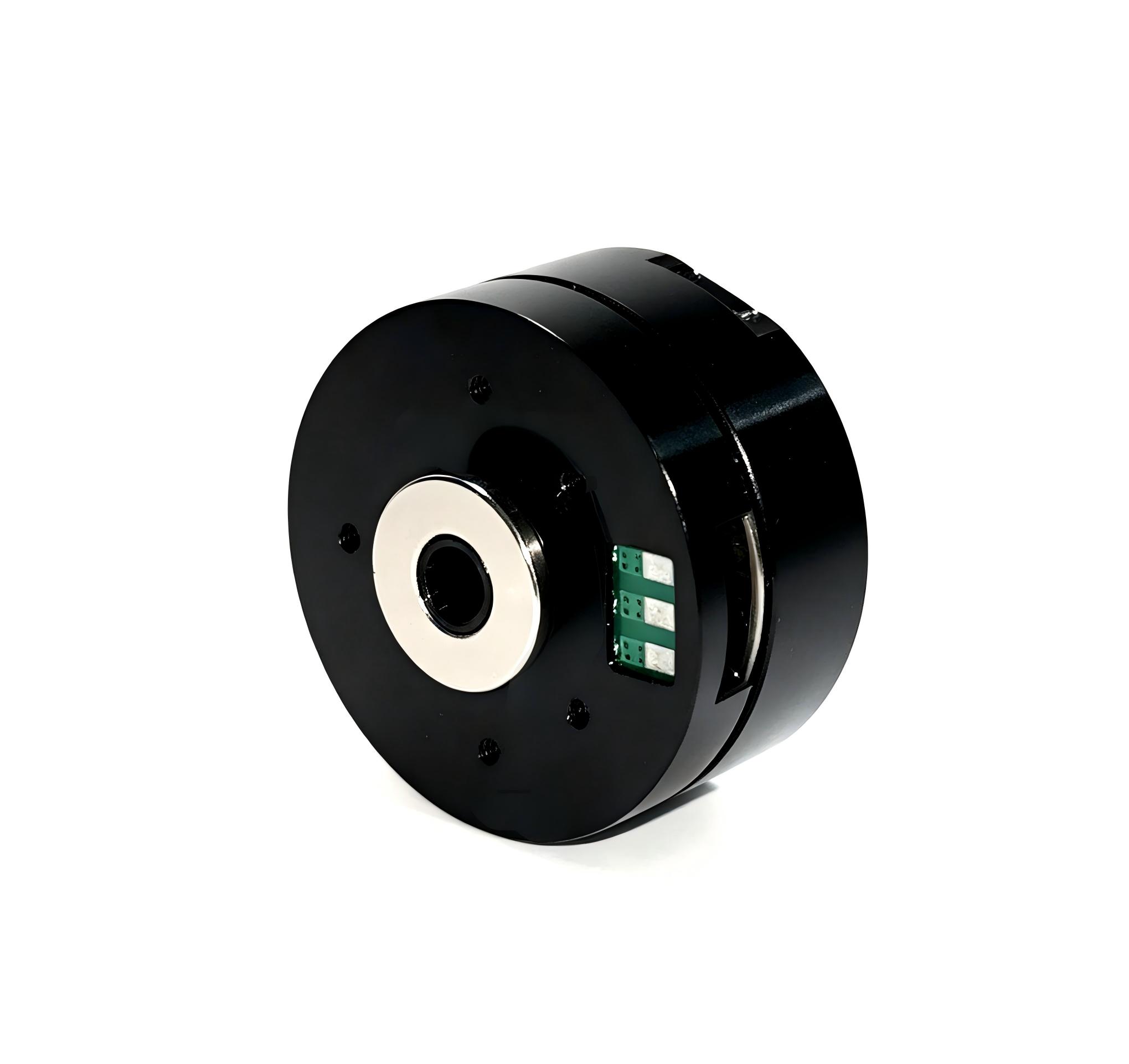
Encoders have long been the default answer for field-oriented control because they hand over rotor position and speed with little uncertainty. The trade-off shows up on the mechanical side: extra shaft length, fragile cabling, connectors that gather dust, and a failure point that often costs more than the motor itself once installation and maintenance are counted. Sensorless control used to be the compromise for fan and pump loads where dynamic response hardly mattered. That version of the story is now outdated.
A practical sensorless drive today rarely relies on a single estimator across the whole operating range. Back-EMF and flux observers handle mid-to-high speeds with enough bandwidth for demanding acceleration profiles. At standstill and very low speed, high-frequency injection can track magnetic saliency through the current ripple, so the drive can hold rated torque before the shaft begins moving. Blending these methods with careful transition logic keeps the estimate stable through startup, sudden load changes, and reversals.
There is still a parameter sensitivity cost, but it is being managed with online adaptation rather than accepted as a fixed limit. Rotor resistance, stator resistance, and inductance drift can be compensated continuously, and modern controller bandwidth makes the observer errors small enough to matter only in edge cases. The point is no longer to save money by deleting the encoder. It is to build a drive that avoids a fragile mechanical feedback path while staying close to the torque and speed control quality that closed-loop vector users expect.
Winding Patterns That Make Panning Feel Immediate
Short, curling pan curves hit differently than a slow linear sweep. When the motion winds back on itself just before reaching the edge, the ear catches the change earlier, so the placement feels less like an effect and more like the sound is actively moving inside the mix.
Tempo-synced arcs that alternate between tight spirals and quick hard pans tend to create that immediate, almost physical pull. Leaving a few milliseconds of silence or a narrowed stereo image right before the pan snaps outward also makes the next movement register faster, without needing wider settings.
The trick is to keep the winding uneven enough to feel alive. A pattern that folds inward, pauses for a fraction of a beat, then pushes across the field gives the listener just enough time to sense the shift before it happens, which makes the pan feel reactive rather than automated.
Thermal Design Keeping Long Takes Drift-Free
Heat is rarely the first thing anyone blames when a long take starts to wander, but it is often the quiet culprit. A sensor that warms unevenly can expand just enough to nudge the flange distance, while rising dark current slowly lifts the shadow floor and shifts color response. The thermal design here does not simply chase lower temperatures; it flattens thermal gradients across the sensor plane and lens mount, using a combination of low-expansion materials and direct thermal coupling to the chassis. The result is a camera that behaves more like a stable optical bench than a heat source bolted to a lens.
Much of the work happens in how heat is routed rather than how hard it is pushed out. Instead of concentrating cooling around one side of the sensor, the internal layout spreads dissipation symmetrically so no single corner of the imaging plane drifts faster than another. That symmetry matters more than peak cooling capacity for long-form work. A steady-state temperature, even a warm one, produces fewer focus and black-level surprises than a system that cycles between hot and cold. The goal is not ice-cold electronics; it is repeatable geometry and consistent noise performance from the first minute to the ninetieth.
For operators, the payoff is unglamorous but practical. You can lock focus, set your framing, and let the camera run without needing to babysit subtle back-focus changes or recheck black balance as the room warms up. Long takes stay sharp not because the camera never gets warm, but because its thermal design keeps the critical dimensions and sensor behavior from drifting out of agreement.
Shenzhen’s Iteration Speed Turns Motor Concepts into Rigs
In Shenzhen, a motor concept rarely stays on a CAD screen for long. A stator lamination stack, magnets, and a set of bearings can be picked up in Huaqiangbei on a Saturday afternoon, and by Monday morning a rough test rig is bolted together on the third floor of an industrial park. That speed is not a slogan; it comes from dense supply chains, small-batch machining shops, and technicians who have wound, milled, and wired so many motors that they no longer need detailed drawings to understand what a design is trying to do.
The iteration rhythm changes how engineering decisions are made. Instead of spending weeks evaluating tolerances or waiting for a custom encoder, teams in Shenzhen often build a deliberately rough version first, put it under load, and then revise based on temperature, vibration, and noise. Failure is cheap enough that testing two or three rotor geometries in parallel feels more sensible than holding long meetings to choose one correct option. That culture turns motor concepts into real rigs at an unusual pace, and it also turns nearby suppliers into informal engineering partners.
The system is not polished. Documentation often lags behind the physical work, version control blurs during rapid changes, and a design can drift as multiple hands adjust it. But for teams trying to prove whether a motor concept actually works, the trade-off is usually worth it. A motor can go from a rough sketch to a torque curve on a dyno in weeks rather than quarters. What Shenzhen offers is not simply cheap labor; it is the ability to compress time.
Modular Cores and the New Payload Math
The old habit of quoting a single payload figure for a launch vehicle falls apart once the core stage becomes a modular building block. A three-core stack rarely triples the lift capacity of a single stick, because the center core throttles down, propellant crossfeed shifts burn rates, and the structural load paths change with every attachment point. Payload math now has to track those interactions instead of assuming a fixed configuration.
Engineers working with modular cores build mass models that treat the vehicle as a set of reusable elements with adjustable constraints. The payload number emerges from a trade between extra thrust, added dry mass, and the timing of separation events. Small changes in strap-on core performance or propellant residuals can produce larger swings in usable payload than static performance tables would suggest, so the math leans heavily on Monte Carlo runs and hardware-in-the-loop data rather than clean closed-form estimates.
That shift also changes how missions are quoted and sold. A payload envelope becomes a curve, not a point: same core mix, different staging velocity, different useful mass. The modular approach rewards teams that treat flight hardware as inventory and performance as a range, because the real question is no longer how much a rocket can lift in isolation, but what a given set of cores can do under a specific mission profile.
FAQ
Chinese manufacturers now pair redesigned stator-rotor geometries with higher-pole-count brushless motors, which reduces cogging torque and allows finer control at low speeds. Feedback loops have also tightened, so stabilization systems can react to micro-jitter that older designs tended to miss.
They tend to offer strong torque density in small packages while keeping per-unit costs reasonable. The close proximity of magnet suppliers, precision machine shops, and driver electronics makers in manufacturing hubs also speeds up design changes and helps keep batch quality consistent.
Newer motors deliver more continuous torque without a large jump in diameter or mass. That means a single-handed stabilizer can hold a cinema body with a prime lens while still responding smoothly to the operator, so users rely less on bulky counterweights or dual-handle rigs.
The motor is only half the story. Chinese engineering teams have refined field-oriented control and adaptive filtering to match each motor's electrical traits, which lowers noise, reduces heat, and improves recovery from sudden pans or bumps.
They show up in drones, inspection robots, wearable cameras, and small gimbals for sensors. Any task that needs steady pointing or vibration isolation can benefit from the same compact torque and precise low-speed response.
The supply chain is tightly clustered, so magnet producers, bearing shops, winding services, and testing labs are often close by. Engineers can run small trial batches, adjust magnetic gaps or winding patterns, and get results quickly without waiting weeks for overseas parts.
Many have shifted toward automated winding, laser alignment checks, and traceable batch records. Long-duration oscillation tests and thermal cycling are also used to catch weak points before a design goes to customers.
Peak torque alone won't reveal much. It helps to check the torque ripple curve, continuous torque at operating temperature, encoder resolution, and how smoothly the driver firmware handles low-speed reversals. A strong bench-test number can still feel jittery if the controller isn't well matched.
Conclusion
The latest wave of Chinese gimbal motors is less about raw specs and more about where those specs are earned. Torque density now gets decided in the magnet gap itself, with tighter air gaps and refined magnetic circuits giving compact motors the authority to hold heavier camera bodies without ballooning in size. That shift pairs well with sensorless control methods that no longer treat the absence of an encoder as a compromise. By reading back-electromotive force and current signatures more intelligently, these drives keep startup and low-speed response clean enough for locked-off shots while cutting wiring and cost. Winding patterns have also moved from afterthought to tuning tool: distributed and skewed configurations make slow pans feel direct and immediate, reducing the mushy correction that used to plague handheld work.
Thermal behavior matters just as much when a gimbal has to survive long takes or hot outdoor sets. Improved stator materials and heat paths keep resistance shifts small, so horizon drift stays out of the frame even as motors warm up. Shenzhen’s supply chain turns these ideas into physical rigs within weeks, letting motor designs iterate faster than most overseas teams can schedule a review. The result is a modular core approach where the same motor family gets rehoused, re-wound, or re-tuned for mirrorless, cinema, or lightweight drones. Payload math has changed accordingly: instead of matching a motor to a camera by weight alone, operators now look at stiffness, thermal headroom, and response feel as part of the same equation.
Contact Us
Contact Person: Sean
Email: [email protected]
Tel/WhatsApp: +86-13338694967
Website: https://www.retekmotion.com