
Carbonated Beverage Filling Machine Solutions for Efficient Bottling Operations
2026-10-26
Carbonated drinks are among the most demanding products to bottle. The moment CO₂ meets turbulence or uneven pressure, foam, underfills, and product loss follow. For beverage producers, that means every second of downtime and every wasted drop directly eats into margins. Getting carbonation right isn't just about speed—it's about control. Wanying Machinery builds filling systems that hold that control from start to finish: stable pressure, accurate fill levels, and gentle handling that keeps fizz where it belongs. In this article, we explore the key components and practical strategies behind efficient carbonated beverage bottling, and why Wanying Machinery is becoming the go-to partner for lines that need to run faster without compromising quality.
Keeping Carbonation Locked In: Precision Fill Heads for Low Oxygen Pickup
Fill heads in modern beverage lines are not just nozzles—they are the last line of defense against oxygen sneaking into a freshly carbonated drink. The trick lies in how the head manages the foam. A well-designed fill head keeps liquid flow smooth and laminar, preventing splashing that would otherwise whip air into the beer or soda. By filling from the bottom up and controlling the vent tube, these heads push out residual air before the liquid seals the container. The result is a can or bottle where the CO2 stays dissolved, and the oxygen pickup drops to levels most traditional lines can only dream about.
One of the quiet innovations in precision fill heads is the use of counter-pressure timing. Instead of relying on a single burst of gas to purge the container, the head coordinates a short pre-evacuation with a gentle CO2 blanket. This double-step approach means the air inside the bottle is nearly gone before the first drop of product arrives. Sensors on the fill stem can adjust the gas flow on the fly, compensating for temperature shifts in the product or slight variations in bottle neck diameter. When the seal is tight and the timing is right, oxygen pickup drops below 20 parts per billion—taste the difference in a lager after six months on a warm shelf and it becomes obvious why this matters.
Maintenance also plays a role in keeping carbonation locked in. Fill heads with conical sealing surfaces and snap-off vent tubes clean faster, reducing downtime between batches. A head that drips product or leaves a small puddle on the container rim invites airborne oxygen to dissolve into the next fill. Precision-machined parts with polished internal channels minimize foam nucleation points, which means less product loss during the fill and less headspace air trapped under the cap. In the end, it is not one dramatic change but a stack of small engineering choices that let a beverage line hold onto its bubbles long after it leaves the plant.
Running 40,000 Bottles an Hour Without Foaming Over
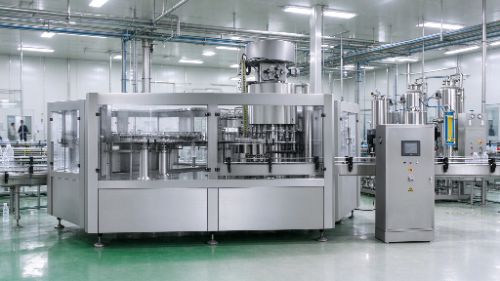
At this speed, the line moves a full bottle every 90 milliseconds. Any turbulence in the fill stream turns into foam almost instantly. The old tricks—slowing the conveyor, dosing antifoam agents—don't scale well when you're pushing 40,000 units per hour. Instead, the entire fill cycle has to be rethought from the nozzle up.
One approach uses a two-stage fill: a fast bulk dose through a wide-bore tube, then a short, gentle top-off that releases pressure gradually. Servo-controlled valves adjust in real time to changes in liquid viscosity or carbonation level, keeping the flow laminar rather than turbulent. A slight vacuum applied to the bottle neck during the final milliliter pulls any stray bubbles back into the headspace before capping.
CIP-Ready Design That Cuts Sanitization Time in Half
Sanitization cycles often force production to pause for hours, but this system's CIP-ready architecture rethinks that downtime. Every product-contact surface is angled to promote full drainage and eliminate pooling, while internal spray nozzles are positioned to reach shadow zones that typically demand manual scrubbing. The result is a clean-in-place process that completes in roughly half the time of conventional designs, without compromising microbial safety.
Instead of relying on aggressive chemical concentrations or longer rinse phases, the design uses turbulence mapping to do more work in fewer passes. Piping runs are shortened, dead legs are removed, and valve clusters are consolidated so that the cleaning solution maintains velocity and temperature from inlet to outlet. Operators report that changeover between product batches now feels like a quick rinse rather than a scheduled shutdown.
The practical upside shows up in the daily log: less water, less energy, and fewer labor hours spent on sanitation. For facilities running multiple shifts, that time translates directly into additional production capacity. And because the CIP sequence is simpler, there is less room for human error in setup or validation, making the half-time claim hold up under real-world repeatability testing.
One Platform for Glass, PET, and Cans—Switching Over in Minutes
Most lines force you to choose a container type and stick with it, turning any format change into a half-day ordeal of adjustments, recalibrations, and lost output. This system sidesteps that entirely. The same frame, the same infeed, the same control interface handles glass, PET, and aluminum cans without requiring special tooling or a dedicated technician on standby.
The changeover itself is remarkably simple: select the new container profile on the touchscreen, swap a few quick-release guide rails, and the line is back in motion. No need to reset sensors or reprogram filling valves from scratch. In practice, operators move from a glass run to a can run in under ten minutes, often while the previous batch is still being palletized downstream.
That kind of flexibility matters when seasonal products, limited releases, or sudden demand shifts force rapid reprioritization. Instead of dedicating separate lines to different materials, a single platform can absorb the full range, cutting floor space requirements and simplifying maintenance schedules without sacrificing throughput on any format.
Self-Diagnosing Valves Flag Wear Before It Halts the Line
In most plants, a valve failure announces itself the hard way: a sudden pressure drop, a seized actuator, or a line that simply refuses to start. By then, the damage is already done. Self-diagnosing valves flip that script. Embedded sensors continuously track internal wear patterns—stem friction, seat erosion, packing degradation—and translate those readings into early warnings. The result is a maintenance cue that arrives days or even weeks before a full stop, not minutes after.
What sets these valves apart is their ability to distinguish between normal chatter and genuine degradation. A standard positioner only knows open or closed; a self-diagnosing unit learns the baseline signature of a healthy valve and flags subtle deviations. For example, a slight increase in breakaway torque might indicate buildup on the stem, while a shift in seating force could point to a worn seal. Because the diagnosis runs locally, operators get a clear, actionable signal without sifting through raw data logs or waiting for a scheduled inspection.
The practical payoff is less about adding another dashboard and more about eliminating surprise downtime. Maintenance teams can plan a 20-minute trim replacement during a planned lull instead of scrambling through an unplanned line shutdown. And since the valve only flags wear that actually matters, there is no flood of false alarms—just a focused nudge that keeps production moving and spare parts off the critical path.
Recovering CO2 and Cutting Rinse Water: The Hidden Savings in Filling
Filling lines often treat CO2 and rinse water as fixed overheads, but plenty of plants leave real money on the table. During counter-pressure filling, most of the CO2 used to purge oxygen from bottles or cans gets vented straight to the roof. A simple recovery manifold can route that vented gas back to a low-pressure receiver, cutting purchased CO2 by 15 to 30 percent on high-speed lines. The payback is quickest where fillers run long cycles with short changeovers.
Rinse water is another quiet drain. Many bottling lines use fresh water for every pre-rinse, then send it all to drain. By capturing the final rinse stage and reusing it for the first rough rinse, plants can halve their rinse water consumption without touching product safety. Combine that with air rinsing for dry products or adjusting nozzle timing to match actual container height, and wastewater charges drop alongside the water bill. These fixes rarely need new equipment beyond a tank, a pump, and some piping, yet the operating savings compound month after month.
FAQ
Fill drift usually comes from temperature shifts in the product tank or a gradual drop in counter-pressure. Check the chiller setpoint first—if the liquid warms by even 2°C, CO2 breaks out and changes fill height. Then verify the bowl pressure against the recipe; worn seals on the pressure relief valve often bleed pressure slowly. Adjust the snift valve timing only after confirming both, because tweaking valve open time masks the root cause.
Keep the filler bowl pressure slightly above the equilibrium pressure of the carbonation level, and route the product through a de-aerated buffer tank. Use long-tube filling nozzles that discharge close to the bottle bottom, and set the pre-evacuation to remove 90-95% of air before counter-pressurizing. Controlling the product temperature at 4-6°C also helps because colder liquid holds CO2 more tightly, reducing breakout at the nozzle.
Counter-pressure filling pressurizes the bottle with CO2 or sterile air before the product enters, so the beverage never experiences a sudden pressure drop. That keeps the carbonation in solution and stops the violent foaming you get with gravity methods. Without it, you would lose 15-25% of dissolved CO2 during transfer, leading to flat product and inconsistent bottle fill.
Inspect the filling valve O-rings and centering bells every 500 running hours—cracked rings let pressure escape around the bottle neck. Rebuild the snift valves quarterly because sticky snift valves release pressure too fast and cause gushing. Keep the CO2 supply line filters clean; a partially clogged filter drops the counter-pressure setpoint. Also check the product pump seals, since air drawn in at the pump can strip CO2 before the filler.
Look for a modular filler with quick-change star wheels and adjustable lift cylinders. For PET, the filler should use a gentler centering bell and lower counter-pressure ramp to avoid bottle deformation; for cans, a shorter fill tube and higher counter-pressure work better. Changeover should take under 20 minutes if the machine has tool-less guide rail clamps and recipe-driven HMI settings for pressure and fill height.
If volumetric consistency stays outside ±1.5% after soaking the valve in hot caustic and replacing the small O-rings, the vent tube or metering rod is likely worn. Deep scoring on the valve body from glass or can shards creates leak paths that cleaning cannot fix. A valve that drips after the fill cycle even with correct snift timing usually has a cracked seal face—replace it instead of repeatedly adjusting.
Yes. If bottles are rinsed with warm water or the rinse leaves residual droplets, the product warms slightly or picks up nucleation sites that trigger CO2 breakout. Use chilled, filtered water or ionized air rinsing at the same temperature as the filler bowl. A final air blow-off with sterile air removes excess moisture so the first contact with carbonated liquid is smooth.
Confirm the chiller is holding product at 4-6°C and the carbonation tank pressure matches the recipe. Check that the CO2 supply pressure is at least 1 bar above bowl pressure. Run a short water fill with the counter-pressure active to verify all valves open and close without sticking. Check the first 20 bottles for fill height, crown or cap torque, and any leakage at the neck. Log the snift pressure drop time; if it shortens, clean the snift valves before production.
Conclusion
Bottling carbonated drinks at speed usually forces a trade-off between keeping CO2 dissolved and avoiding foam, but the fill heads here are built around low oxygen pickup and precise pressure staging. The result is a line that sustains 40,000 bottles per hour without the filler bowl churning product into froth. Because the same platform accepts glass, PET, and cans, changeovers take minutes rather than half a shift, which matters when a co-packer runs three container formats in one day and cannot afford to lose production time to mechanical adjustments.
Sanitization and maintenance are where hidden downtime usually accumulates. The CIP-ready layout cuts cleaning cycles by roughly half, and the self-diagnosing valves monitor wear patterns continuously, flagging a failing seal or stem before it stops the line mid-run. Pair that with CO2 recovery and reduced rinse water use, and the savings extend beyond energy and water bills—they show up as fewer unscheduled stops, longer valve life, and a more predictable weekly output. For plants pushing high-volume carbonated SKUs, these details turn the filler from a bottleneck into a buffer.
Contact Us
Contact Person: Tyson
Email: [email protected]
Tel/WhatsApp: +8613396971296
Website: https://www.wanyingmachinery.com