

Best Digital Oscilloscopes for Precise Signal Analysis in 2025
2026-05-27
In the fast-paced world of electronics, nothing beats the clarity of a precise signal. Whether you’re debugging a finicky microcontroller or validating a high-speed communication link, the oscilloscope is your window into the invisible. But with so many options flooding the market in 2025, how do you choose one that truly captures every nuance without breaking a sweat? It’s not just about bandwidth or sample rate anymore—modern designs demand tools that blend raw performance with intuitive features. That’s where TPS comes into the picture, redefining what it means to see your signals clearly. In this post, we’ll explore the digital oscilloscopes that are setting the standard for accurate analysis this year, and why your next measurement might just depend on the one you haven’t tried yet.
Redefining Signal Fidelity with Next-Gen ADC Architectures
The pursuit of pristine signal conversion has driven a quiet revolution in analog-to-digital converter design. Emerging architectures are dismantling the old trade-offs between speed and precision, leveraging techniques like noise-shaping SAR and continuous-time pipeline hybrids. These designs don’t just incrementally improve specs—they fundamentally alter how we capture real-world signals, pushing effective resolution closer to theoretical limits even at multi-gigahertz bandwidths. The result is a new class of ADCs that redefine fidelity by preserving the subtle details traditional converters would smear or discard.
At the heart of this shift is a move away from rigid, single-topology thinking. Designers are blending sampling methods, dynamically reconfiguring feedback paths, and employing advanced calibration that runs in the background without interrupting operation. For instance, integrating a mostly digital loop filter alongside a fast SAR core slashes power while keeping linearity in check—something previously thought impractical. These architectural cross-breeds sidestep the usual bottlenecks, delivering a purity of signal capture that feels almost analog-like in its transparency, yet with the robustness of digital processing.
What truly sets these next-gen ADCs apart is their ability to adapt in real time to signal conditions. Rather than being fixed-function blocks, they sense the input’s characteristics and shift their conversion strategy on the fly—prioritizing dynamic range when signals fade, or bandwidth when pulses sharpen. This context-aware conversion ensures that fidelity isn’t just a static number on a datasheet but a lived-in performance that holds up across unpredictable, real-world environments. It’s a leap beyond merely lowering noise floors; it’s about making the converter an intelligent participant in the signal chain.
Field-Ready Precision: The New Wave of Portable Oscilloscopes
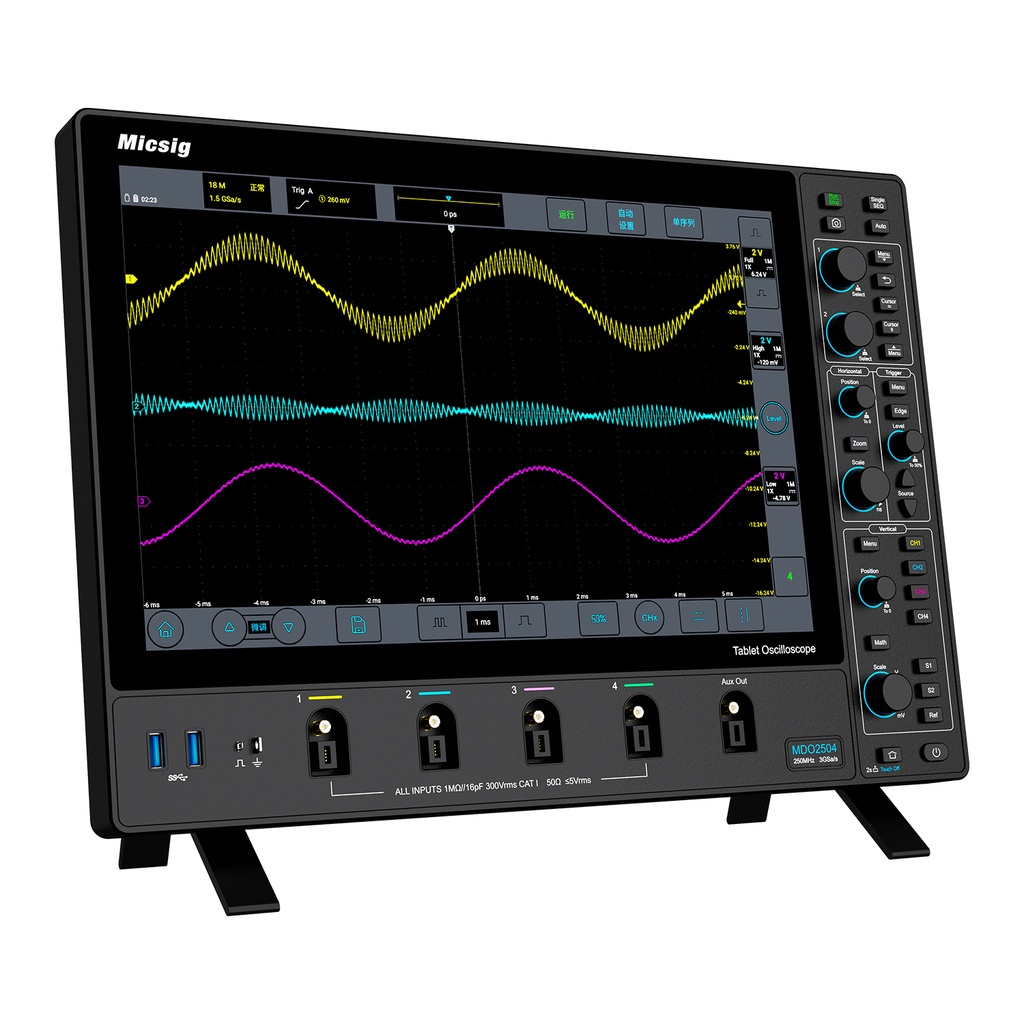
Modern field engineers are trading in their bulky benchtop units for tools that won’t slow them down. Portable oscilloscopes now pack lab-grade measurement accuracy into a form factor that survives drops, dust, and damp conditions, without forcing anyone to squint at a tiny screen or compromise on bandwidth.
The real shift isn’t just about size—it’s about how these devices handle real-world signals on the spot. With isolated channels, long battery life, and intuitive touch interfaces, troubleshooting a motor drive in a noisy factory or verifying a sensor output on a rooftop becomes as straightforward as it would be back at the bench. You’re not just carrying a scope; you’re carrying a complete analysis setup that fits in one hand.
What sets the latest generation apart is how seamlessly they bridge raw hardware capability with software-driven insight. Automated measurements, serial bus decoding, and even basic spectrum analysis happen right on the device, cutting out the delay of post-processing on a laptop. For the engineer who needs answers now—not after a trip back to the lab—this wave of portability is less a luxury and more a redefinition of field readiness.
Deep Memory, Smarter Triggers: Unveiling Signal Anomalies
Modern monitoring systems often drown in noise, missing the subtle patterns that precede critical failures. Deep memory architectures change this by retaining long-term behavioral context, allowing the system to compare current signals against weeks or months of historical norms. Instead of reacting to every spike, it learns what truly deviates from baseline—spotting anomalies that static thresholds would never catch.
Smarter triggers take this a step further by combining deep memory with adaptive logic. Rather than firing on isolated data points, these triggers evaluate sequence patterns, correlation shifts, and gradual drift. They suppress false alarms while surfacing the kind of complex, multi-signal anomalies that indicate real operational risk, such as cascading microservice failures or silent data corruption.
Unveiling these hidden anomalies transforms how teams respond to incidents. By highlighting the precise moment a system veered off course, deep memory and intelligent triggers enable faster root cause analysis and proactive intervention. This approach moves beyond simple alerting—it delivers a continuous understanding of system health, turning raw data into actionable insights that keep services resilient.
Beyond the Time Domain: Scopes That Master RF and Serial Protocols
Oscilloscopes used to be defined almost entirely by their time-domain credentials—bandwidth, rise time, and sampling rate told you everything you needed to know. That narrow focus misses the reality of modern embedded debugging, where a single board might mix a baseband analog sensor signal with an SPI bus, a BLE radio front-end, and a high-speed SerDes lane. The instruments that thrive in this world treat the traditional scope display as just one of several concurrent views. They let you snap a spectrogram of intermittent RF interference, drop markers on a packetized serial decode, and still keep an eye on the raw voltage profile that started the whole investigation.
What makes these multi-domain scopes genuinely useful isn’t the feature checklist—it’s the way they correlate across domains. A glitch on a power rail can fold into a serial protocol error that triggers a radio retransmission; spotting that chain by paging through separate instruments is slow and error-prone. When the same timebase drives an FFT view, protocol tables, and analog waveforms simultaneously, you can grab a spectral peak, zoom into the offending time region, and see exactly which I²C transaction lined up with the noise burst. That kind of workflow turns a bench full of disparate boxes into a single coherent debugger, and it saves more hours than any bandwidth upgrade ever will.
Streamlined Workflows: From Touch Interfaces to Cloud Integration
The way we interact with tools has shifted dramatically—starting right at our fingertips. On a tablet or a responsive kiosk, a couple of taps and swipes can set off a chain of actions that would have once required a stack of paperwork. Designing these touchpoints isn’t just about making them look clean; it’s about understanding exactly when to surface the next logical step so someone can move through a task without second‑guessing. A well‑tuned interface practically disappears, turning a complex process into a quiet, almost physical routine.
What really transforms a smooth touch experience into something powerful is what happens next—those moments when the work leaves the device. Instead of living in isolation, the input flows straight into a shared cloud workspace where permissions, versioning, and notifications are already sorted. Team members might see updates arrive on their own screens in real time, or an automated trigger could kick off a downstream step like generating a report or ordering supplies. The handoff feels invisible, which is the whole point.
The glue that holds this together is rarely a single dramatic integration. More often, it’s a set of lightweight connectors and well‑defined data endpoints that let the front end and back end stay loosely coupled. When a change is needed—say, a new approval rule or a shift to a different storage provider—the interface doesn’t need to be rebuilt from scratch. That kind of resilience means teams can evolve how they work without breaking the rhythm they’ve already built.
Future-Proofing Your Bench: Key Oscilloscope Trends for 2025
The test bench of 2025 won't just be faster—it'll be smarter. Oscilloscopes are evolving beyond simple waveform capture into analytical hubs that spot anomalies before you do. Machine learning models, once a novelty, are now baked directly into measurement routines, flagging intermittent glitches and correlating them with power rail fluctuations in real time. This shift means engineers spend less time staring at screens and more time solving root causes.
Bandwidth and sample rate wars are cooling off; what matters now is how well your scope integrates with the rest of your toolchain. Expect USB4 and PCIe 6.0 compliance testing to become table stakes, while multi-domain analysis—linking RF, digital, and DC signals on one timeline—takes center stage. The real differentiator will be how seamlessly your scope connects to version control systems, lab management software, and even cloud-based data lakes for long-term trend analysis.
Finally, the physical interface is getting a quiet overhaul. High-resolution capacitive touchscreens, customizable zones, and voice-activated measurements are moving from luxury to necessity. Probes with embedded memory for auto-identification and self-calibration eliminate setup guesswork. In a world where debugging windows shrink by the quarter, these ergonomic leaps aren't just nice—they're what keep you ahead of the next design spin.
FAQ
Look for high bandwidth and sample rate, low noise floor, advanced triggering, and deep memory. Models with 12-bit ADCs are becoming more common, offering better vertical resolution for spotting tiny anomalies.
The Keysight Infiniium UXR-Series remains a benchmark for ultra-high bandwidth applications. For mixed-signal work, the Tektronix 5 Series MSO is highly flexible and user-friendly. Rohde & Schwarz also introduced the RTO6 with exceptional signal integrity.
Yes, the Siglent SDS2000X Plus series provides 10-bit resolution and a large touchscreen at a moderate price. Rigol’s MSO5000 is another popular choice, featuring an impressive 9-inch display and deep analysis capabilities.
Both matter, but they serve different roles. Bandwidth determines the highest frequency you can measure accurately, while sample rate ensures you capture enough points per waveform. A good rule is to have a sample rate at least 2.5 times the bandwidth, but for precise edge analysis, more is better.
Many new scopes now include integrated protocol decoders for standards like USB 4.0 and PCIe 6.0. Enhanced FFT functions, zone triggers, and automatic power analysis are also becoming standard. Connectivity via LAN and cloud storage integration is a plus.
While not replacements for dedicated spectrum analyzers, many digital oscilloscopes now offer advanced FFT with decent dynamic range. Models like the Tektronix 6 Series B have built-in spectrum analysis capabilities that suffice for many RF troubleshooting tasks.
Choose a platform that offers software upgrades and hardware expansion. Modular systems like the National Instruments PXI-based scopes allow you to swap modules. Also, look for manufacturers providing regular firmware updates that add new analysis features.
Absolutely. Modern handheld scopes, such as the Fluke 190 Series, feature isolated channels and rugged builds without sacrificing measurement accuracy. USB-based oscilloscopes like the Picoscope 6000E offer lab-grade specs in a portable form factor.
Conclusion
Digital oscilloscopes in 2025 are pushing the boundaries of precision with architectures that prioritize raw signal fidelity. At their heart, next-generation ADCs deliver higher resolution and lower noise floors, ensuring that even subtle waveform nuances are captured cleanly. This leap in converter design is no longer confined to benchtop giants—it now powers a fresh breed of portable scopes that bring lab-grade accuracy into the field. Whether troubleshooting industrial sensors on a factory floor or validating high-speed designs on a crowded bench, engineers can rely on instruments that refuse to compromise between mobility and measurement integrity. Meanwhile, deep acquisition memory working in tandem with smarter, application-aware triggering helps isolate intermittent glitches that older systems would miss, turning hours of hunting into seconds of insight.
Modern scopes have also broken out of the traditional time-domain box. Integrated protocol decoders, spectrum analysis, and even full vector signal analysis allow a single instrument to tackle mixed-signal, RF, and serial bus challenges without swapping gear. This convergence is complemented by redesigned user experiences: capacitive touch displays, drag-and-measure gestures, and seamless cloud connectivity let teams annotate waveforms, share data instantly, and even update firmware from anywhere. Looking ahead, trends like wider adoption of real-time de-embedding, machine-learning-assisted anomaly classification, and modular upgrades are shaping a future where the oscilloscope acts not just as a debugging tool but as a centralized analysis hub. The best digital oscilloscopes of 2025 thus blend breakthrough hardware with intelligent software, future-proofing your bench for the unpredictable demands of tomorrow’s electronics.
Contact Us
Contact Person: Lily
Email: [email protected]
Tel/WhatsApp: +49 (0) 2161 49526-0
Website: https://tps-elektronik.com/en/