

Best Boron Carbide Ceramic for Extreme Hardness and Durability
2026-10-27
When pushing materials to their limits, few ceramics rival boron carbide for extreme hardness and lightweight durability. Yet not all boron carbide performs equally under ballistic impact, high-stress wear, or thermal shock. The difference lies in raw material purity, sintering precision, and quality control—areas where HUAYI TECH has honed its expertise for over a decade. If you need a material that refuses to fail when it matters most, this guide reveals what truly separates best-in-class boron carbide from the rest.
What Makes Boron Carbide Unusually Hard
The exceptional hardness of boron carbide stems from its unusual crystal structure, where twelve-atom icosahedra are linked by short covalent bonds to three-atom chains. These boron-rich icosahedra are incredibly rigid, resisting deformation under load, while the interconnecting C-B-C chains add directional strength. Unlike many hard materials that rely on a single bond type, boron carbide combines strong covalent bonding within and between clusters, creating a three-dimensional network that distributes stress evenly and prevents easy crack propagation.
Another factor is the material's low density paired with high electron deficiency. Boron atoms have only three valence electrons, yet they form five or six bonds in the icosahedra, leading to electron-poor multi-center bonding. This unusual bonding arrangement actually stiffens the lattice, as atoms are locked into positions that require immense energy to displace. The result is a structure that barely yields under pressure, ranking just below diamond and cubic boron nitride in hardness but surpassing them in some ballistic applications due to its lighter weight.
The arrangement also limits slip systems—planes along which crystals typically deform. In most materials, hardness is compromised by dislocations moving easily through the lattice. In boron carbide, the complex icosahedral network blocks dislocation motion, forcing any applied force to be absorbed elastically or through fracture rather than plastic flow. This combination of rigid clusters, multi-center bonding, and restricted dislocation mobility is what gives boron carbide its signature resistance to scratching, indentation, and wear.
How Its Low Density Reshapes Armor Design
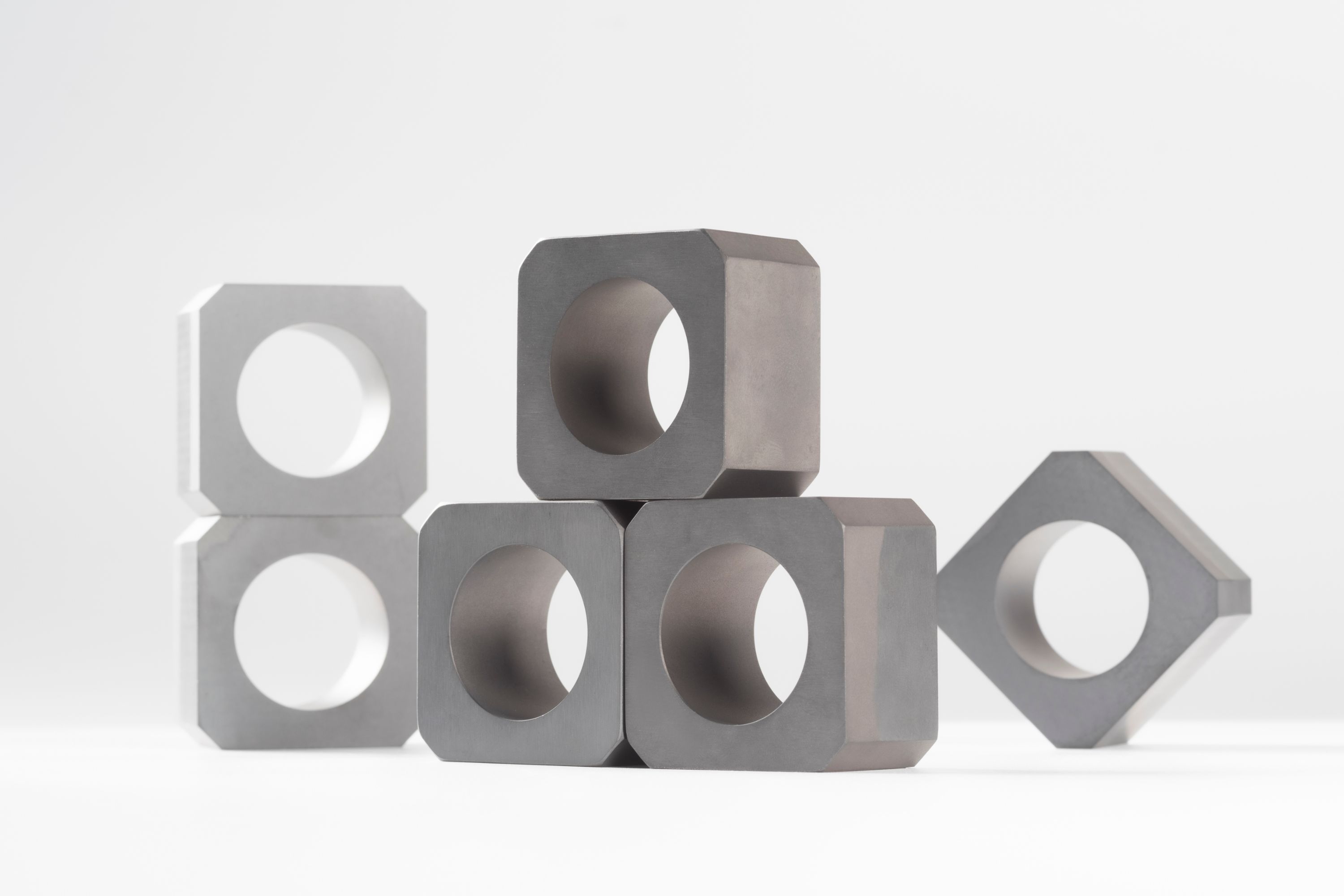
Low-density materials upend one of the oldest assumptions in armor design: that protection always scales with weight. Traditionally, adding more steel or ceramic means adding more mass, which limits how much armor a vehicle, aircraft, or person can carry. A material with significantly lower density breaks this link. Designers can now afford to increase the physical thickness of a protective layer without pushing the overall weight budget beyond acceptable limits. This thickness becomes a tool in itself, enabling spaced or layered configurations where the first layers disrupt a projectile, the middle layers spread the load, and the back layers catch fragments. The result is not just lighter armor, but a different geometry of defense that was impractical when every millimeter of added protection carried a heavy penalty.
The low density also changes which parts of a platform can realistically be protected. In the past, areas like a vehicle’s roof, floor, or side skirts were often left thinly armored because the weight of full coverage was prohibitive. With low-density armor, those neglected zones can receive meaningful protection without sacrificing speed, range, or payload. For a soldier, this means the difference between a vest that covers only the torso and one that extends to the neck, shoulders, and upper arms while still allowing mobility. The design question shifts from “where can we afford to put armor?” to “where do we actually need it?”, because the mass penalty is no longer the primary constraint. This broader coverage is especially valuable against threats like improvised explosive devices or top-attack munitions, which target precisely the areas that heavier armor left exposed.
Beyond weight savings, low-density armor often exhibits a fundamentally different response to impact. Many low-density materials—such as metallic foams, honeycombs, or certain polymer composites—deform through crushing or cell collapse rather than brittle fracture or localized penetration. This crushing process absorbs energy over a longer displacement, reducing the peak force transmitted to the underlying structure or body. Dense armor, by contrast, tends to stop a projectile by shattering it or by blunting it through extreme hardness, which can still produce high back-face deformation or spalling. Low-density armor spreads the impulse over time and area, turning a sharp impact into a slower, less damaging push. This shift from resisting penetration to managing energy flow requires designers to rethink armor not as a wall, but as a sacrificial system that uses its own low mass to win the energy exchange.
Grinding Wheels That Outlast Standard Abrasives
Most grinding wheels wear down long before the abrasive grains themselves lose their cutting edge. That's the problem with standard abrasives—the bond holding the grains together breaks apart unevenly, so fresh sharp grit never gets exposed. This wheel takes a different route. The grain spacing and bond formula are tuned so that dull grains release at a steady, controlled rate, keeping the contact surface sharp for far longer.
On a busy shop floor, that translates into fewer wheel changes, less dressing time, and a more consistent finish from the first part to the last. Operators notice the difference quickly: the wheel doesn't glaze over after a handful of passes, and it doesn't load up on soft metals the way conventional discs do. Instead of fighting the tool, they can keep the feed pressure steady and let the wheel do the work.
Durability here isn't just about a harder bond. It's about matching the abrasive type to the material being ground and keeping heat buildup low enough that the bond stays intact. The result is a wheel that might cost more up front, but outlasts standard options by a wide enough margin that the per-part cost actually drops.
Neutron Absorption Without Heavy Shielding
Traditional neutron shielding often relies on bulky materials like concrete, water, or boron-loaded polyethylene, but a quieter approach is emerging from the chemistry of high-cross-section absorbers dispersed in lightweight matrices. The goal is not to stop neutrons by sheer mass, but to capture them efficiently through resonant absorption, turning kinetic energy into harmless gamma or charged particles that can be locally contained. This shifts the design logic from dense walls to smart, thin composites that exploit isotopic selectivity, especially for thermal and epithermal neutron spectra common in medical and research facilities.
Materials such as lithium-6, gadolinium, and samarium offer orders of magnitude higher neutron capture probability than iron or hydrogen, yet they are rarely used as bulk shields because of cost, reactivity, or secondary radiation. The practical alternative is to embed these absorbers as fine powders or thin films within polymers, ceramics, or even borosilicate glass fabrics. By tuning particle size and distribution, neutron mean free paths drop dramatically without adding significant mass or volume. This is particularly valuable in portable neutron sources, spacecraft instrumentation, and wearable dosimetry, where every kilogram carries a penalty.
A less obvious benefit is the reduction of activation products. Heavy shields often become radioactive themselves after prolonged exposure, creating disposal headaches and background noise for sensitive detectors. Layered designs that combine a thin thermal neutron absorber with a fast neutron moderator, both engineered from low-activation elements, can outperform a foot of lead or steel while remaining serviceable and safe to handle. The future of neutron protection is therefore less about building thicker barriers and more about designing smart, multi-functional surfaces that absorb, scatter, and dissipate radiation on a molecular scale.
Sintering Tactics for Flaw-Free Components
Getting a sintered part to come out without cracks, warping, or porosity rarely hinges on a single setting. It is more about how well the heating profile matches the powder blend and the part geometry. A slow ramp through the binder burnout stage prevents trapped gases from pushing the compact apart, while a shorter hold near the peak temperature lets necks form without excessive grain growth. Small adjustments here often do more than chasing a higher furnace temperature.
Furnace atmosphere is another variable that gets overlooked. A slightly reducing gas can keep surface oxides from interfering with neck formation, but it also risks carbon pickup in some alloys. The trick is to read the exit gas and the color of the finished part, then shift the dew point or flow rate before dimensional drift shows up in a full batch.
Packing and support matter just as much as the thermal cycle. Tall or thin-walled green bodies sag if they are not bedded in a way that allows uniform shrinkage. Using setter plates with the same expansion coefficient as the workpieces, and leaving enough room for the part to move during densification, prevents the kind of hidden stress that turns into hairline cracks after cooling.
Edge Retention in Demanding Cutting Tools
Maintaining a sharp cutting edge under extreme stress is what separates premium tooling from ordinary stock. In high-feed milling or interrupted turning, the microstructure of the tool material dictates how long that edge survives before micro-chipping begins. Carbide grades with a fine grain size and a balanced cobalt binder tend to resist fracture while still allowing enough toughness to absorb shock. The result is a slower, more predictable wear pattern instead of sudden edge collapse.
Coatings also play a decisive role, but they must complement the substrate rather than mask a weak foundation. A thin, highly adherent layer of titanium aluminum nitride can reduce friction and heat buildup at the cutting zone, preventing the edge from softening prematurely. However, if the coating is too thick or poorly bonded, it flakes away under load and leaves the raw edge exposed. The best edge retention comes from a system where coating hardness, substrate toughness, and geometry all work together.
Real-world performance hinges on how the tool handles thermal cycling and chip flow. Every pass heats the edge, then cooling between cuts creates repeated expansion and contraction. Tools that retain their edge longest are often those with a slight hone or chamfer, which distributes cutting forces over a broader area and reduces the peak stress at the very tip. Attention to these details keeps the cutting edge working longer without frequent indexing or replacement.
FAQ
Its crystal structure combines boron and carbon in a way that gives it a Vickers hardness often above 30 GPa, second only to diamond and cubic boron nitride among commonly available ceramics.
It resists wear exceptionally well because the strong covalent bonds prevent material loss even when sliding against hardened steel or abrasive slurries.
Armor systems, sandblasting nozzles, nuclear shielding, and precision lapping tools all use boron carbide when failure is not an option.
Density above 2.5 g/cm³, uniform microstructure, low porosity, and sharp grain boundaries are signs that the material will perform reliably under stress.
Yes, it maintains its hardness at elevated temperatures better than many alternatives, though oxidation resistance above 600°C may require a protective coating.
Boron carbide is harder and lighter, but silicon carbide is tougher and cheaper. For pure wear resistance, boron carbide often wins; for impact-heavy environments, silicon carbide may last longer.
Absolutely. Its low density of about 2.52 g/cm³ paired with extreme hardness makes it a favorite for body armor plates and helicopter seats.
Beware of low density, microcracks from poor sintering, or overly aggressive binder phases that weaken the ceramic. Always ask for a density report and micrograph.
Conclusion
Boron carbide earns its place among the hardest engineering ceramics through a crystal structure built from covalently bonded icosahedra—twelve-atom boron cages linked by short, stiff carbon chains. This arrangement leaves almost no room for atomic slip, so the material withstands point loads that would indent most other solids. Just as important for armor, its density hovers near 2.5 g/cm³, roughly a third that of steel and well below alumina. Designers exploit that low mass to build body armor plates, helicopter seat pans, and vehicle spall liners that shed kilograms without compromising multi-hit resistance against rifle threats.
The same hardness makes boron carbide a first choice for grinding wheels used on hardened tool steels and cemented carbides, where it keeps cutting long after standard abrasives round over. In nuclear facilities, its boron-10 content captures thermal neutrons so efficiently that compact plates and pellets can replace heavy water tanks or lead bricks around reactor cores and spent fuel casks. Producing these parts with true structural integrity is not trivial: boron carbide resists densification, so pressure-assisted sintering with carefully chosen additives and controlled ramp rates is needed to eliminate pores and prevent grain growth. That disciplined microstructure pays off again in cutting tools, where fine grains and near-zero porosity let edges resist chipping and wear through thousands of interrupted cuts in abrasive composites. In harsh wear and radiation environments, that balance of hardness, low density, and neutron control is difficult to match.
Contact Us
Contact Person: Junting Leo
Email: [email protected]
Tel/WhatsApp: +86 18615009766
Website: https://www.huayimaterial-china.com/