

Aluminum Pilot Boat Factory: Inside Advanced Marine Manufacturing
2026-08-27
No blueprint can capture the noise, the sparks, or the precision inside a modern aluminum pilot boat factory. At Allheart, we’ve spent years refining that process—and for the first time, we’re walking you through it. From raw plate to sea-ready hull, this is advanced marine manufacturing without the filter.
Why Aluminum Wins the Hull Game
When it comes to choosing a hull material, aluminum consistently outshines its rivals for a simple reason: weight. A lighter hull means a faster boat with better fuel economy, and aluminum delivers that without sacrificing strength. Unlike fiberglass, which often needs extra reinforcement to handle impacts, aluminum's inherent toughness lets builders use thinner sections while maintaining hull integrity. That translates to less draft, easier trailering, and a lively ride that heavier steel or wood hulls simply can't match.
Corrosion resistance is where aluminum really earns its keep in saltwater. Modern marine-grade alloys, especially those in the 5000 and 6000 series, form a tough oxide layer that shrugs off the constant assault of seawater and sun. You don't need to worry about osmotic blisters, rot, or rust—common headaches with fiberglass and steel hulls. Maintenance drops to little more than a freshwater rinse now and then, which means more time on the water and less time with a sander or paintbrush.
Beyond durability, aluminum's strength-to-weight ratio opens up design possibilities that other materials can only dream of. Welded aluminum construction allows for complex shapes, integrated fuel tanks, and custom layout changes without the need for expensive molds. Repair work is straightforward for any competent welder, unlike fiberglass which often requires specialized skills and controlled environments. For boaters who want a hull that adapts to their needs and stands up to decades of hard use, aluminum isn't just an option—it's the obvious winner.
The Welding Bays Where It All Comes Together
Step past the safety curtains and the first thing you notice is the light—sharp blue arcs strobing across the floor, each one a brief sun. The welding bays don't feel like a side stage; they're the center of gravity. Here, raw steel sections meet at odd angles, get tacked into place, and then the real work begins. A welder leans into the joint, torch angled just so, and for a few seconds the world shrinks to a puddle of molten metal. The hiss of shielding gas mixes with the clatter of clamps being repositioned, and every now and then a grinder cuts in, throwing its own orange sparks into the mix.
What makes this space unusual isn't just the skill on display—it's the rhythm. One booth might be laying down a long, steady bead on a frame rail while the next is finishing a series of short stitch welds on a mounting bracket. Jigs get swapped, measurements double-checked, and the pieces that leave these bays are no longer a collection of cut profiles. They've become something that can hold weight, take vibration, and stay true. That's the moment the rest of the line is waiting for: when the parts finally come together strong enough to build on.
A Hull's Journey From Flat Plate to Sea-Ready
Every hull begins as an unremarkable rectangle of steel or aluminum, flat and lifeless on the shop floor. The first cuts follow chalk lines and CNC paths, peeling away the excess until a collection of plates starts to suggest the intended shape. Heat and pressure then coax those plates into gentle curves, a process that feels more like persuasion than manufacturing. Each bend brings the metal closer to the water it has never touched.
Once the shell plates are tacked and welded into a continuous skin, internal framing takes over. Frames, stringers, and bulkheads are fitted piece by piece, turning a fragile shell into a rigid structure capable of resisting waves and cargo loads. The hull is then faired, coated, and fitted with the piping, shafting, and rudder gear that will make it a functioning vessel rather than a steel sculpture. It is during this stage that the flat plate truly disappears, replaced by a shape with purpose and direction.
The final leg of the journey happens at the water's edge. Cranes lift the hull from its building cradle, and for a moment the entire structure hangs free, still dry and silent. Then the hull is lowered, the water takes the weight, and the first small movements of a living ship begin. What was once a stack of flat plates has become sea-ready, not because of any single dramatic moment, but through hundreds of quiet, deliberate steps.
The Relentless Testing Every Pilot Boat Must Survive
Before a pilot boat ever delivers its first harbor pilot to a towering container ship, it gets beaten senseless in a series of trials that would send most workboats back to the yard. Hull panels are slammed repeatedly into head seas until strain gauges confirm the framing won’t buckle. Weld seams get inspected for hairline cracks after every cycle. Designers push the boat past its rated limits in simulated storm conditions, measuring torsional flex and slamming pressures that can exceed several times the static load. If a single bracket shows fatigue, the design goes back to the drawing board—there is no room for failure when a pilot ladder hangs over the side in a confused sea.
Propulsion gets its own kind of torture. Engines run at full throttle for hours, then get thrown from full ahead to full astern without cool-down. Hard-over rudder tests at maximum speed leave a wake that looks like a corkscrew, while engineers monitor gearbox temperatures and shaft alignment. The boat must hold station alongside a moving ship in a crosswind, make a tight turn inside its own length, and stop from flank speed in a distance short enough to avoid a collision. Cooling systems, fuel filters, and hydraulic steering are all pushed until something nearly gives—and if anything actually does, the builder fixes it and the test starts over.
The last round is the one that separates real pilot boats from showpieces. The vessel goes out into the worst water the coast can offer—steep chop, strong tide, maybe a gale warning in effect—and performs full pilot transfer drills with a weighted dummy. Stability tests with off-center loads and full fuel tanks prove it can recover from a beam sea without rolling over. Emergency systems are tripped, from engine-room fire suppression to man-overboard retrieval. Only after the boat survives these relentless, near-destructive trials does it get the nod to carry a pilot, because out there, the boat is not just a ride—it’s the only thing standing between a harbor pilot and the open sea.
What Makes These Boats So Light Yet So Tough
The secret starts with the core materials. Instead of solid fiberglass, many modern lightweight boats use carbon fiber or Kevlar laminates over a honeycomb or foam core. That sandwich construction creates a stiff panel without the weight, so you get a hull that resists flexing under load yet can be lifted by two people at the dock.
The resin matters just as much as the cloth. Vacuum infusion pulls epoxy through the fibers evenly, eliminating puddles and air pockets that would otherwise add dead mass. Builders also trim every extra ounce by placing reinforcement only where the stress maps show it's needed, not across the whole skin. The result is a boat that shrugs off rocks and chop while staying easy to car-top.
The Hands and Jigs Behind a Custom Build
Most custom work is shaped before the first cut, but not in drawings alone. It happens in the way a woodworker's hands remember pressure, angle, and the slight give of a particular species. Jigs simply extend that memory. A block of scrap clamped at an odd offset, a wedge cut from offcuts to hold a curved part steady, a router guide with one edge taped to correct a quarter-millimeter drift: these are not accessories. They are quiet decisions made in the middle of a build, and they usually look rough because they only need to work once.
That roughness is the point. When a builder makes a jig in ten minutes, it carries the same logic as the final piece but without the pressure to be presentable. A stop block can replace three measurements. A curved caul can apply clamp force where parallel clamps can't reach. The hands learn to read the jig's limits—where it flexes, where it slips—and compensate almost without thinking. That feedback loop is invisible in the final object, but it's why two pieces built from the same plan can feel completely different.
Eventually, the best jigs are not the ones bought from a catalog. They're the ones made twice because the first revealed a flaw in the approach. A small error becomes a shim, a shim becomes a reference surface, and by the end the bench is covered in oddly shaped helpers that will never be used again. That's not waste. It's the record of hands learning the work as it goes.
FAQ
Aluminum gives a high strength-to-weight ratio, resists saltwater corrosion, and lets the yard build lighter, faster hulls that still hold up under repeated contact with ship sides.
Certified marine welders work in enclosed bays using pulsed MIG and TIG rigs, and every critical seam gets dye penetrant or radiographic checks before any coating goes on.
Most are deep-vee planing hulls with a sharp entry and broad chines, which keeps speed and stability up in rough water while cutting down on deck spray.
The wheelhouse sits amidships with shock-mitigating seats, there is a heated cabin with bunks for off-watch crew, and a dedicated aft boarding platform supports safe transfers.
Watertight compartments below deck, self-righting capability on select models, continuous side-deck grab rails, and quick-release boarding ladders come as standard.
Depending on length and owner specifications, a build typically runs eight to fourteen months, including sea trials and final acceptance runs.
CNC plasma cutting tables shape hull plates, automated welding cells handle long straight seams, and an overhead gantry moves hull modules between assembly stations.
Yes, buyers can specify engine packages, navigation electronics, crew seating arrangements, hull colors, and rescue gear to match local operating needs.
Conclusion
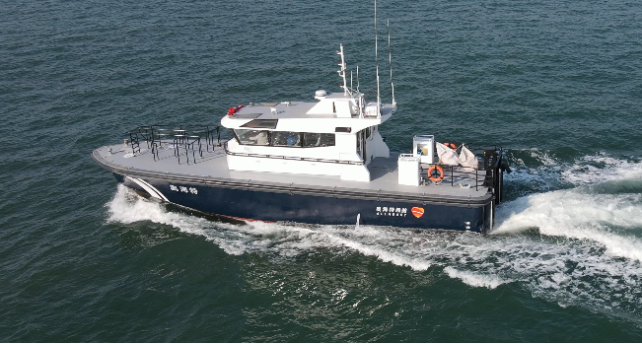
Inside an aluminum pilot boat factory, the reason hulls are aluminum is immediately obvious. Marine-grade aluminum shrugs off saltwater corrosion better than steel, yet its density keeps the boat light enough to sprint alongside massive ships and nimble enough for ladder transfers in rough water. In welding bays, fabricators turn flat plate into three-dimensional hulls: CNC-cut panels, precision jigs, and pulse MIG welds that lock each seam without warping the metal. A hull's route from raw sheet to sea-ready vessel passes through multiple stations—forming, framing, deck fitting, then outfitting—with each stage checked against jigs that hold tolerances to a few millimeters.
The real proof comes later. Every pilot boat must survive brutal testing: repeated hard landings, full-throttle slamming trials, watertight integrity checks, and load tests on lifting eyes and handrails. Alloys like 5083 and 5383 are chosen because they resist fatigue and stress cracking while keeping weight down. Internal frames and collision bulkheads add stiffness without robbing speed. What makes these boats so light yet so tough is this combination of alloy, welded monocoque structure, and careful heat control during fabrication. Behind each custom build are the same hands that set the jigs, run the beads, and sand the hull fair—so no two pilot boats feel exactly alike, even when they share a mold line. The factory is less an assembly line than a collaboration between metal and the people who know how to make it flex, float, and take a pounding for decades.
Contact Us
Contact Person: Benny Hu
Email: [email protected]
Tel/WhatsApp: +8618354225697
Website: https://www.allheartmarine.com/